.

Showing posts with label Annuals. Show all posts

Colorful Coleus


If you want a plant that can give you lots of summer color, plant coleus (Solenostemon). This is a plant that I really like in the garden because of the many colors and the impact of color that they can give to your landscape beds, containers and hanging baskets.


Coleus are easy to grow annuals that need full sun to grow well, but they can take part shade. They should be planted in a sheltered location and kept moist. Make sure that your plants have ample water in periods of dryness. Coleus prefer a well drained fertile soil when planted in the ground. If you plant in containers, use a good quality commerical soil mix. A slow release fertilizer should be added when you plant them. Fertilize plants every two weeks with a liquid fertilizer.


Pinching out the growing tips and removing flowers will encourage bushy growth and more of those colorful leaves. Coleus can grow from 8 to 18 inches tall depending on the variety.


When fall comes, you can dig up and pot these beauties to keep them in the house or greenhouse during the winter. In the spring, you can pinch off  tip growth and make cuttings from them. I start my cuttings by putting them in a glass of water. I change off the water every other day to keep the water fresh. They root very quickly. I then pot them up and let them grow till they are ready to go to the garden. Make sure that you acclimate your plants to the outdoors in the spring for at least a week before moving them to full sun. Coleus are also easy to grow from seed.


If you want some great color for the garden, plant coleus! 


Happy Gardening!

Debbie

What's New in the Garden


It has been a very busy gardening season this year.  Since we have been receiving normal amounts of rainfall this year, it has allowed me to start working on a major project of redesigning and adding new garden beds. The project is taking longer due to a foot injury earlier in the year and with all the rain, dealing with lots of mosquitoes.  Working in the garden has not been as pleasant when you have to wear long pants, long sleeves, gloves and mosquito netting over your head. The project is coming along and with the rain, everything is growing great. I will take this weather anytime over the drought of last year.

I received lots of new plants to trial this year and I have been very excited with all of them.  Over the next few posts, I will share with you some of my favorites.  In the picture above, the dark colored plant on the right side is Colorblaze Marooned or Solenostemon scutellarioides by Proven Winners.  I received this trial plant to try last year and I overwintered it to enjoy again this year. It has a stunning dark color and has been a great plant to grow. The other plant on the left side is Superbells Pomegranate Punch or Calibrachoa hybrid. The flowers are deep red with a black red center. I really like this plant. It blooms well, is disease resistant and really is pretty.  I have heard lots of good comments on this plant from other garden writers who are growing it. It will be available from Proven Winners in 2014. 

Check back over the next few weeks for information and pictures of other great trial plants that are growing in my garden.

Happy Gardening!

Debbie

I am writing for Indiana Gardening Magazine. Check out my story on Growing Tropical Plants in Containers at http://statebystategardening.com/in/newsletter/

Shade Loving Plants for the Woodland Garden


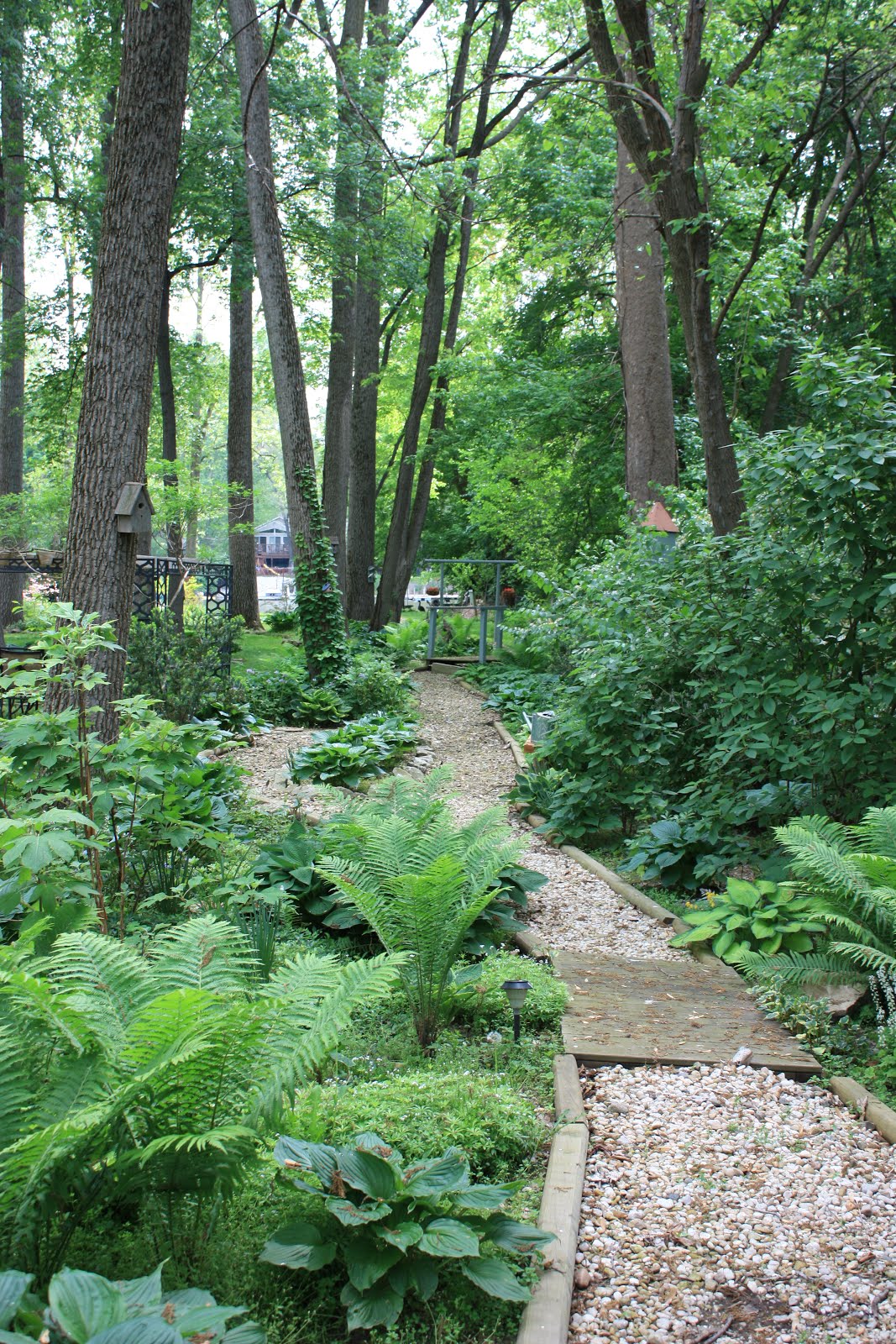
The Woodland Garden in the Summer
One of my favorite gardens is the Woodland Garden.  Woodland Gardens appeal to me because they are not formal, take less work to maintain and it is a garden designed to appear the way that nature would have made it.  They are relaxing, slightly unkempt, and lush with plantings. Woodland Gardens are places where you just want to sit down, watch the birds and squirrels and enjoy the life around you. 
If you have a wooded area in your landscape, consider designing a Woodland Garden.  Start with an entrance to the garden, like an arbor or gate.  Add a pathway to lead you into and around the garden.  A path can be river rock, mulch, or just dirt.
This garden can be all native plantings or it can contain selected shade loving perennials, shrubs, trees and bulbs that you like.  In my garden, I prefer a combination of natives and plants that I enjoy. I try to add plantings that add year round color in leaves, flowers and bark.  I also add early blooming shrubs and bulbs to start this garden into bloom after a long cold winter.
Plant selection is important in the Woodland Garden.  Plants need to be shade loving and able to survive in low light conditions. They also must be able to tolerate dry conditions that can occur in the summer and competition from the surrounding trees.  Here are a few of my favorite plants in my garden.
 
Annabelle Hydrangea
Assorted colors of  Hosta
Ghost Fern

Japanese Painted Fern


Forget- Me- Not
Virginia Bluebell
Assorted Foam Flowers


Oakleaf Hydrangea with fall color
Oakleaf Hydrangea with Ostrich Ferns

Variegated Solomon's Seal and native Solomon's Seal
Yellow Archangel  (AGGRESSIVE)

Assorted colors of  Hellebore for spring color
Wood Poppy
Sweet Woodruff
Marsh Marigold
Prairie Trillium
Grape Hyacinth

A shrub that I like in my garden is Witch Hazel, which can come in shades of yellow or orange for spring color. I also like  Dogwood and Red Bud trees for their spring color.  Look for shrubs and trees that have blooms and variegated leaves for added color that can be placed along the outside edge of your Woodland Garden.  Native plants that I like are Bloodroot, Mayapples, Jack in the Pulpit and Wild Ginger. Do your research on what plants are available in your area or that are native.

Next week, I plan to make a trip to the Indianapolis Home Show to visit their gardens. Check back for some new pictures of spring flowers.  Those of us who live in cold climates are ready for Spring to arrive!

Please check out "Garden Thyme with the Creative Gardener" on Facebook and check out my pins on Pinterest for more on gardening. Be a "Follower"

Happy Gardening!

Debbie


Senorita Blanca

 
Over the summer, I had the opportunity to try a new plant in the garden.  Proven Winners sent me three trial plants of Senorita Blanca, which is a Cleome hybrid. I have grown Cleome in the garden before, but this one was different. What I liked about this plant was that when it started blooming, it just kept on producing blooms till the first killing frost took the plant. The flowers are all over the plant and not just on the top of the plant. The plant performed very well in all the heat  and humidity that we had. Last year was a tough year in the garden due to a three month drought.
 
 
Senorita Blanca needs full sun and grows to a height of 24 to 48 inches with a spread of 18 to 24 inches.  The flowers are white to a pale lavender in color and last a long time on the plant.  This plant is sterile, so you will not have seed set and have cleome coming up all over the garden. It was easy to care for and no deadheading was needed.  An extra bonus to this plant was that butterflies and hummingbirds were attracted to it, a must in my garden.
 
I really liked this plant and was sad to see the frost kill it.  It was one of the few plants in my garden that performed well during the drought last year.  This is one plant that I will be adding to my garden again next season.
 
Happy Gardening!
 
Debbie

Add Some "Spring" to Your Containers

 
Spring is coming and now is the time to start getting that landscape prepared for it's arrival. You can start cleaning up the garden beds, picking up yard debris and pruning different plants in the landscape. Garden maintenance needs to be done early before many of the spring flowering plants and bulbs start to break ground and grow.
 
As you start the process of spring cleanup, consider adding some color to that drab winter garden with some colorful containers of spring flowering plants and bulbs.  Many local stores will be receiving in pots of tulips, daffodils, hyacinths, ornamental cabbage and pansies that can be planted in containers to give some much needed color to the garden. 
 
 
When selecting containers look for ones that compliment the plants that you will be using.  Containers can be ceramic, cement, wood or other types of materials.  They should have good drainage, color and be frost proof. When planting your containers, use a quality soil designed for containers.
 
 Use a thriller, spiller and filler method for planting.  If you have not heard of this method, a thriller would be something big and attractive like the tulips in the picture above.  The filler would be a smaller plant to fill in the pot and the spiller would be a plant that hangs down the sides of the pot. The ivy in the picture above is serving as a filler and a spiller. You can have multiple plants for fillers. Remember to select plants that can withstand changing weather and temperatures based on the zone that you live in.
 
Here are a few examples of  containers and window boxes decorated for spring. You might notice that all the containers used ivy for the spiller plant.  When your containers need to be changed you can remove the spring plants and continue to use the ivy with summer and fall blooming plants.
 
Azalea and ivy
 
Daffodils, spikes and ivy
 
Tulips, daffodils, ivy and a houseplant
 
Azalea and ivy
 
Assorted spring bulbs with ivy
 
Cyclamens and ivy
 
Assorted spring bulbs with ivy
 
Tulips, pansies and ivy
 
Tulips, ivy and pansies
 
 
When preparing your containers for spring, add some moss or wood mulch on top of the soil for some added protection for the plants from the cold.  Use one or group several containers together for added color and balance. Don't forget to add some colorful containers inside your home to enjoy.  Now get out there and start getting that garden ready for spring!
 
Happy Gardening!
Debbie