.

Showing posts with label spring blooming flowers. Show all posts

California Poppies (Eschscholzia californica)

Last year I bought a packet of California poppy seeds. I planted the poppy seeds in the fall just like I do my red corn poppies and here they are now. The blooms are bright and nothing short of spectacular. The foliage isn't too shabby either. It reminds me very much of the foliage of my 'Powis castle' artemisia, silvery in hue with feather like leaves.

Most of the California poppies I planted are in a front garden area I started also in the fall. The poppies provide some late spring and early summer color in this garden.


I planted a few 'Caradonna' salvias from cuttings nearby which actually became enveloped by the poppies. Behind them both is a 'Golden Jubilee' Agastache and the blade like leaves of several irises. Next year this whole garden should look like river of flowers going from daffodils in early spring to irises in late spring. The summer blooming flowers like coneflower, 'Montauk' daisy, and various annuals will fill out the outside areas.


Why do I like to plant poppies?
  • Poppies are easy to sow - just sprinkle the seeds in the fall.
  • Poppies are easy to grow - just let mother nature have her way with them. Despite the current drought cycle we're in the poppies haven't stopped blooming!
  • Poppies look awesome!

Are your poppies still blooming?

Just a Poppy Picture!


Due to mowing last evening a more detailed post about plant propagation was not possible - coming soon though! For now enjoy the poppy! For more poppy pictures look here: Performance of the Poppies!

And check out Nell Jean's Poppy post at Secrets of a seed Scatterer!

Performance of the Poppies!

Every year one of the great performances in my garden is the performance of the poppies. These simple red flowers came in a free packet of seed several years ago and still keep on putting on powerful displays of red paper-like petals. With as easy as poppies are to grow and maintain (I do nothing other than spread the seeds every now and then) it makes me wonder why they aren't in every garden? Poppy seeds planted in the fall bloom the following spring and produce seed pods with lots of little tiny poppy seeds. I think I should add a few additional colors of poppies to the self-sowing garden for some variety.


Do you plant poppy seeds in your garden? Or are they just in your muffins? ;)

My Favorite Native: Honeysuckle!

This time of year the native honeysuckle growing on my arbor is one of the showiest flowers around. Tons of flowers are covering the controllable version of lonicera. The native honeysuckle goes by the name of Lonicera sempervirens and not Lonicera japonica. I have the exotic foreigner too but it came with the garden! And it's been ignoring my eviction notices. The difference between the two is their growth habit. The native honeysuckle grows at a pace where the garden can actually keep up with its maintenance. The only drawback is that the native honeysuckle doesn't have the characteristic honey sweet fragrance, but I've talked about native honeysuckle before

Check out that link above for more on the native honeysuckle but for the rest of this post I'll just show you some pretty pictures! Any objections? No? Good! (You really didn't have a choice anyway ;))

This variety is called 'Alabama Crimson'. They really need to hybdridize and orange variety so Tennessee gardeners can plant the 'Orange Vol'.


It's spring, the storms are done for the week, and things are looking up!


Here is a cropped picture from the last post. If you look toward the back of the picture you'll see another honeysuckle. This one isn't a named variety and came forma  cutting from my parent's honeysuckle plant.


Red honeysuckle definitely dazzles this time of year in the garden! And the hummingbirds love it too!

For more on natives join Gail's native wildflower/plant week at Clay and Limestone.

Irises in Spring

Irises! when you think of springtime, do you think of irises? Of course I'm sure you think of all kinds of flowering plants, bulbs, and trees but irises are distinct. They offer a variety of colors, of shapes, and sizes to decorate the spring garden. The irises in my garden have recently begun to color our gardens with their displays and here are a few of the more interesting ones that have bloomed so far.

Purple Bearded Iris - Unknown Variety
 Any ideas?


Lavender Colored Bearded Iris - Unknown Cultivar - Heirloom? 
came from my parent's garden


Purple and yellow bearded irises - Unknown variety - rather plain.


This next iris is my current favorite!
'Solar Fire' iris that I planted last year. The orange and red colors on ruffled petals are amazing!


Irises are the state flower of Tennessee!

Happy Easter!

I won't be posting a Seed Sowing Saturday post this weekend since it's Easter weekend. I've included a dogwood picture and if you would like to read more about dogwoods I wrote post for the Tennessee Gardener online that you may enjoy.  Also for an update on the plants in my garden shed feel free to take a look at the video below.

I hope you have a Happy Easter!


This video was made with my Sony HDRCX130 HD Video Camera.

April is for Awesome Blooms!

Spring is hitting us full force right now in mid April. Flowers are blooming everywhere! The mailbox garden is covered in spring time flowers and in just about every other garden is a spot of color to talk about. This post is plant and garden photo heavy so be prepared!

April Blooms in the Mailbox Garden


We'll start the garden tour with the mailbox garden! It's changed a lot over the years but still has some of the same plants like:
'May Night' salvia


Creeping Phlox with Pansies


'Homestead Purple' Verbena
'Homestead Purple' Verbena is a staple in my garden and is propagated every year to spread around as a filler.

Creeping Phlox, Dianthus, 'May Night' salvia, Verbena in a wider photo shot.

The Front Gardens


More Creeping Phlox


Golden Ragwort


The Corner Shade Garden


It's a sterile hybrid of the Japanese dogwoods (Cornus kousa) and our native Cornus florida.


Japanese maple


Ajuga - Bugle Weed


Solomon's Seal (toward front) and Hellebore (Lenton Rose) in center.


Photos From a Few Other Gardens


Red Honeysuckle (Lonicera sempervirens)

Snowball Viburnum
Still kinda green!


'Shasta' Viburnum (on left) and Lunaria - Moneyplant toward center next to a hosta.


That's it for today! I didn't take pictures of the strawberries - they deserve their own post!
Stop by Carol's blog for more April blooms.

Creeping Phlox and Border Rocks

It seems to me that phlox and rocks just go well together. It's not just the rhyming sounds that make the words blend but it's how the plants and rocks function together. Creeping phlox just loves to wrap itself around nearby objects and rocks are no exception! When I added the border rocks to the front garden I left a few gaps to allow the phlox to slide and creep through toward the lawn.The first picture of the front garden and border was taken a little over a week ago, just when the phlox began to bloom. Behind the phlox are daylilies and salvia which will add the next course of color. I used to have Russian sage in this garden but I moved it to try something new and because it was getting very large!


Here the creeping phlox has filled out with blooms.


I have a Salvia lyrata in the same garden which loves to self sow. Here is it between a couple border rocks.


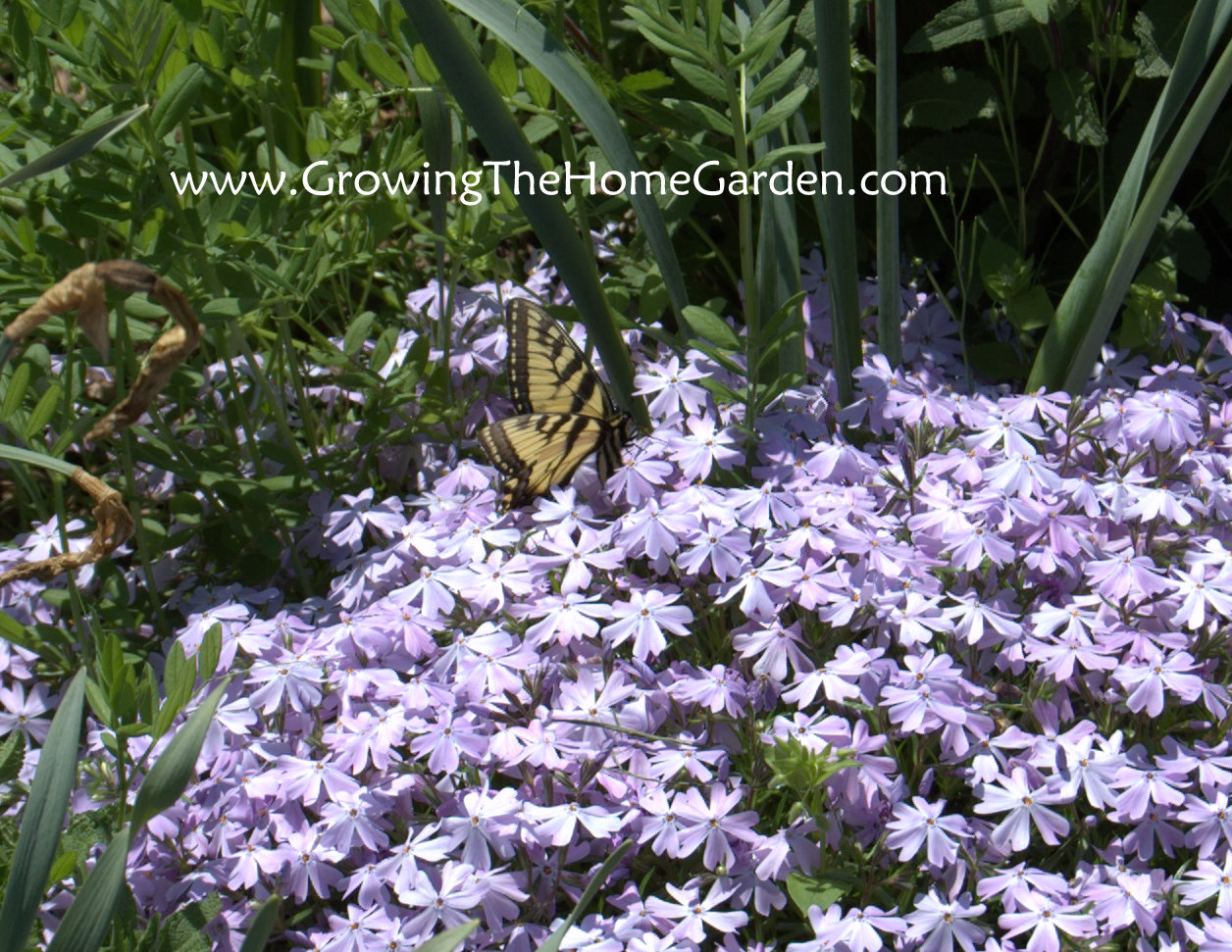
This weekend was the first weekend I've seen the butterflies out in force. Along with this tiger swallowtail I spotted one Monarch butterfly and I didn't have my camera in hand for a picture!


Here are a few pictures of our creeping phlox from last year.
What plants do you use for your borders?

The Front Sidewalk Garden in April

There are few things a gardener appreciates more than see the positive results of his hard work payoff. Over the years I've moved plants, added plants, trimmed plants, propagated plants in various areas and in some places I'm just now beginning to see the results. One such location is my front sidewalk garden. It's the garden between the house and the sidewalk and a narrow strip of garden that runs the length of the sidewalk. In the beginning - no we aren't talking the book of Genesis here - there was nothing, well nothing of appreciable value. Several Japanese hollies had just bit the dust in the freeze of 2007 and the only other thing to make it through was the Nandina.

Negrita
We quickly removed the hollies and tossed them. I found a deal on some densiformis yew. I know yew is rather common but you need some sort of evergreen backdrop for other plantings and at $2 a piece the price just couldn't be beat. They've come a long way since then! Two 'Emerald Gaiety' Euonymous plants were tucked in near the yew. I do not recommend planting this euonymous. It spreads, it runs, I think it may idolize kudzu like little kids idolize that Justin Bieber guy. (Ugh) Still the euonymous really is just a little kid compared to kudzu. I'm rambling now - let's head back to the garden.


Shirley
Later I added catmint which has turned into an incredible performer for me! Tulips came by the names of Negrita and Shirley, sorry no Laverne. They were a big box store buy that has turned out quite well! 'Autumn Joy' sedum found a home here along with everyone's favorite spring blooming ground cover - creeping phlox! I'll show you another garden later this week with a little phlox on the rocks. The opposite side of the sidewalk - the strip side - blooms later in the season with salvias that will emerge by May. I used to have Russian sage but I received too many complaints from important people that the pollinators were taking over the neighborhood. Since then the Russian sage has been moved farther away from the heavily traveled territories of our garden.

I mentioned before that the only thing to make it through the freeze of 2007 was the nandina, that's not entirely true.  Our house was a foreclosure when we bought it and if you know anything about foreclosures you know that often they are let go, both inside and out. The garden was like that too but at some point at realtor came through with a crew to demo the overgrown shrubs in the front garden. One little spirea was cut to the ground and later emerged after we moved in to show off its reddish tinted leaves. Here it is now with its friend phlox. They are pretty good companions although in all honesty I just stuck them together without any thought. It's better to be lucky than good sometimes!

Phlox and Spirea
And here is the garden together. It has three good seasons of interest and a shade of the fourth when the nandina berries are standing out with a bright red for winter color. Daylilies, catmint, salvia, 'Silver Mound' artemisia, gaillardia and a butterfly bush will decorate the front garden in summer. Mums and 'Autumn Joy' sedum will add to the color when fall arrives.


I look forward to the spring every year so I can follow the calendar of color to come!


What do you look forward to about spring each year the most?

Viburnum x burkwoodii 'Mohawk'

I wish you could smell the garden right now.  If I could bring you the scents of my garden through this post I would.  What's making my garden so fragrant?  A combination of two plants: Viburnum x burkwoodii 'Mohawk' and the irises! The combination of the two is bringing a honeysuckle like fragrance to the backyard.  I'm a huge fan of viburnums and my 'Mohawk' is a great one!

Its beautiful white flower clusters appear and spread a fragrance that envelopes a good portion of our backyard.  The flowers will eventually turn into dark reddish to black fruits perfect for the birds to feast upon in late summer and fall (if they last that long).  'Mohawk' is a result of Viburnum x burkwoodii being back crossed to a Viburnum carlesii.


A Plant Propagation Note
Viburnum x burkwoodii 'Mohawk' will propagate from cuttings taken in early spring through summer.  Hardwood cuttings are also effective.
Viburnums like this one and the 'Shasta' viburnum I wrote about yesterday are great for ornamental value and for feeding the birds!  'Mohawk' viburnums enjoy zones 5-8 and thrive in full sun.  We keep it mulched and it stays happy!


A Yoshino Cherry Tree in Full Bloom!

I know that you know that I like Yoshino Cherry trees. I thought I would highlight the Yoshino cherry tree that is flowering in our front yard so that you can enjoy its blooms too! Here's why the Yoshino makes a great garden tree: they grow relatively fast, they look great when in bloom and when covered in leaves, and I've noticed very few pest problems (the deer rubbed it once). Here are a few more good reasons to plant a Yoshino cherry in your garden:


Are you ready to plant one yet?

The Arbor, Daffodils, and the Front Garden

It really seems that spring has sprung already. The warm temperatures have brought everything to life, I only hope that the plants aren't doomed by the next freeze happens to come along. It's reminiscent of the spring of 2007. Back then we had an early warm-up followed by a hard freeze that damaged a significant number of Japanese maples and crape myrtles. I'll keep my fingers crossed but everything is growing in full spring growth mode and I know we have a few freezes ahead. The daffodils have come alive this week and the front porch garden is starting to thicken up with early spring yellow blooms. There are some gaps to fill in and maybe I can make more by dividing a few of the bulbs later in the year.


My arbor has seen some wind damage lately. The diamond shaped decorations on each side have been battered by heavy winds that pulled the chains apart from the structure. It's cosmetic and easily repaired but still another thing to add to the to do list.


In the front porch garden that I began remodeling last fall the glossy leaves of the camellia above are on the same plant as the frost burnt leaves on the tips of the branches below. I have two 'Winter Snowman' camellias in the front garden and one did fine while the other got a little singed. I'll give them both a little pruning this spring and they will recover nicely!


The front sidewalk garden is the home of my tulips which are pushing through the mulch. I planted pansies here in the fall but the tulips will overtake them and you won't even know the pansies are there.


This will probably be the last look at the winter jasmine this year. The picture was taken yesterday before the high winds of last evening and today that blew most of the petals away. You can see the new green foliage beginning to emerge from the stems. Spring is here again!


Has spring arrived where you are yet?