.

Showing posts with label front sidewalk garden. Show all posts

June in the Front Sidewalk Garden

Since I havent' shown the state of the front garden lately now seems like a good time! The daylilies are blooming like crazy (at least the yellow ones are). I'll start with a long shot of the arbor from up the driveway. There are three moonflower vines planted at the base of the arbor that should take off very soon. They like the heat and thrive when temperatures skyrocket in the summer. Next to the arbor is a crape myrtle that looks like it should bloom this year. Our cooler summer temperatures last year never allowed the crape myrtle to really get blooming.


Here along the sidewalk are a mix of salvias and daylilies. In between each of these pairings I planted a purple ruffled basil. I thought the ornamental quality of the dark purple ruffled leaves was perfect combination with the yellow daylilies. The basil is very small right now but should grow fairly fast.


Here's a picture of the sidewalk and its plantings. On the left is a red gaillardia descended from an 'Oranges and Lemons' gaillardia. The seeds don't come true for that one. On the right is another standard plant I put in everywhere - catmint! 'Silver mound' artemisia is pouring over the sides of the sidewalk closer to the house. If you remember photos from previous years in this spot you might recognize something that this garden is missing - Russian sage (Pervoskia atriplicifolia). Don't worry I still have lots of that (As long as I have sun I will have Russian sage!) I just decided to move it. It was a bee magnet which is great but I did receive some complaints about the bees along the walkway. They never bothered me! You can't even tell but I removed at least five daylilies from this area too. I'll show you the new area I planted with the Russian sage and daylilies soon. It needs to be a little more presentable!

The Front Sidewalk Garden in May

One of the coolest things about gardening is that every month brings a new scene. Different plants come to the forefront while others fade away leaving either seed heads or simply foliage in their place. Some may disappear completely among the foliage or die back to the ground revealing new fresh plantings that are coming into their own while some seemingly bloom forever.

My front sidewalk garden changes significantly over the course of a year. The scheme in September is very different from what you see now even though you may see some aspects that are similar. Here is how it appears from partway down the sidewalk. On the right the irises are peaking out toward the sun and mounds of daylily foliage are nearly completely hiding the fading tulip foliage. I like to leave the foliage of bulb plants up as long as possible for them to recharge so disguising the foliage is important. The daylilies do a pretty good job of masking the tulip leaves

 
A close look at the right side of the sidewalk garden reveals a power player in this garden, in fact two of them, 'Walker's Low' Catmint and a butterfly bush. This 'Walker's Low' Catmint is in fact the mother plant for all my other catmints. I save money through propagating my own plants and catmints propagate very easily.  You can even try just sticking a cutting in the ground and you will find some success. Planted en mass catmint looks fantastic.  One of my goals is to propagate enough of it that I can make a small sea of catmint in the backyard. 
I cut the butterfly bush back severely this year and it is springing forward nicely!  All the branches seem to be focused on growing upwards which will give the catmint some space.
  
We have a few foundation plants in this bed. This shaggy looking evergreen is a 'Densiformis' Yew (Taxus) and is one of five in our foundation planting.  A couple 'Emerald Gaiety' Euonymous plants help to add some variegated foliage to the garden.
  
How could I talk about the front garden without talking about the salvia? Salvia is by far one of the best plants you can have in your garden.  Along the sidewalk we have several 'Caradonna' Salvia nemorosas that I propagated last year. If you take basal stem cuttings in the spring you can get blooms the first year, at least you can if you have a long growing season.
I love things that spill out and blur the straight lines and edges of hardscaping. I planted this 'Silver Mound' Artemisia along our front sidewalk and it does a fantastic job of softening the edge. I hope to have 'Silver Mound' running all the way down the sidewalk by summer's end.
  
Here is a closeup of the catmint from earlier. This was the first one in our garden and after one season it is a giant! It's about 3 feet all the way around and loves the location.
  
Blooms like this are all over the catmint. If you don't have one you need to get one and if you have one you need more! It's not the same thing as catnip and doesn't have the magnetic effect on the feline population. I can't help walking by and picking a leaf to smell every time I pass.
  
Here's a new addition, lantana. I'm not sure of the variety but it has a nice yellow color that will add some brightness to our ever present purples flowers.
  
May brings a lot of blooms and at least this year a lot of rain. It's been difficult getting outside to get anything done or even get great pictures for display. Hopefully soon our weather will even out and give us some much needed sunshine! My tomatoes can't survive on a liquid diet alone.

Shirley it's Time for Tulips!

Shirley Tulips in Bloom

And here's where you can find Shirley! The Front Sidewalk Garden. This is the third year the tulips have come back in this garden. I've heard people complain about tulips not returning but these have been very faithful. The front sidewalk garden is located on the north side of our house and receives little sunlight during the winter which probably helps with those necessary chill hours. The purple tulips are 'Negrita' and I'll show more of them later in the week. Neither type of tulip has peaked yet but they are close. In the center of the walkway is creeping phlox which I plan to highlight later in the week also.


What kinds of tulips do you have in your garden?

The Front Sidewalk Garden in April

There are few things a gardener appreciates more than see the positive results of his hard work payoff. Over the years I've moved plants, added plants, trimmed plants, propagated plants in various areas and in some places I'm just now beginning to see the results. One such location is my front sidewalk garden. It's the garden between the house and the sidewalk and a narrow strip of garden that runs the length of the sidewalk. In the beginning - no we aren't talking the book of Genesis here - there was nothing, well nothing of appreciable value. Several Japanese hollies had just bit the dust in the freeze of 2007 and the only other thing to make it through was the Nandina.

Negrita
We quickly removed the hollies and tossed them. I found a deal on some densiformis yew. I know yew is rather common but you need some sort of evergreen backdrop for other plantings and at $2 a piece the price just couldn't be beat. They've come a long way since then! Two 'Emerald Gaiety' Euonymous plants were tucked in near the yew. I do not recommend planting this euonymous. It spreads, it runs, I think it may idolize kudzu like little kids idolize that Justin Bieber guy. (Ugh) Still the euonymous really is just a little kid compared to kudzu. I'm rambling now - let's head back to the garden.


Shirley
Later I added catmint which has turned into an incredible performer for me! Tulips came by the names of Negrita and Shirley, sorry no Laverne. They were a big box store buy that has turned out quite well! 'Autumn Joy' sedum found a home here along with everyone's favorite spring blooming ground cover - creeping phlox! I'll show you another garden later this week with a little phlox on the rocks. The opposite side of the sidewalk - the strip side - blooms later in the season with salvias that will emerge by May. I used to have Russian sage but I received too many complaints from important people that the pollinators were taking over the neighborhood. Since then the Russian sage has been moved farther away from the heavily traveled territories of our garden.

I mentioned before that the only thing to make it through the freeze of 2007 was the nandina, that's not entirely true.  Our house was a foreclosure when we bought it and if you know anything about foreclosures you know that often they are let go, both inside and out. The garden was like that too but at some point at realtor came through with a crew to demo the overgrown shrubs in the front garden. One little spirea was cut to the ground and later emerged after we moved in to show off its reddish tinted leaves. Here it is now with its friend phlox. They are pretty good companions although in all honesty I just stuck them together without any thought. It's better to be lucky than good sometimes!

Phlox and Spirea
And here is the garden together. It has three good seasons of interest and a shade of the fourth when the nandina berries are standing out with a bright red for winter color. Daylilies, catmint, salvia, 'Silver Mound' artemisia, gaillardia and a butterfly bush will decorate the front garden in summer. Mums and 'Autumn Joy' sedum will add to the color when fall arrives.


I look forward to the spring every year so I can follow the calendar of color to come!


What do you look forward to about spring each year the most?

My State of the Garden Address

Our president gave us his State of the Union address for 2010 this week and informed us of his plans and his thoughts so I thought why not do the same for my garden? It’s been a while since I’ve addressed the garden as a whole entity as usually I just discuss its parts or its plants. Let me start off by saying it’s not necessarily a pretty picture. It is winter after all!

As I walked around the gardens today I had an opportunity to view what has been accomplished and what has yet to be done. The front garden hasn’t undergone many changes over the last year but it is due for some redeveloping. The Russian sage on the left of the sidewalk has grown large and it is time for it to be tamed or moved. It’s wispy and bare now but its white stems make an attractive winter feature and would look especially nice in front of an evergreen backdrop. I clip it back each spring but it likes to grow, and grow, and grow - I really can’t blame it! I have some options on a new location but then I’ll have to figure out what to put in its place…

Front Sidewalk Garden in January  1-2010-1

I walked around the other side of the house to the self-sowing/self-seeding garden. It's inaugural year was very progressive and was full of blooms. Rudbeckia, sunflower, salvia, zinnias and several other plants filled up the seats in this garden.

Self-Seeding Garden in Winter 1-2010-1

And I couldn’t fully evaluate the state of the garden without the arbor. (Arbor and The House) I still enjoy looking at it. I feel like I won the BHG.com prize even though I lost out to a front porch repainting (it was pretty, definitely not our style though!). I saw in the recent Tennessee Gardener magazine and article about roses that had pictures of roses climbing all over gates – it’s a very tempting idea for this arbor don’t you think?

Pathway Entry Arbor in Winter 1-2010-1

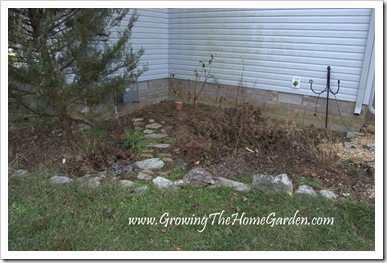
Past the arbor you will find one of my favorite gardens – during the growing season that is! The corner shade garden is filled with heucheras, hostas, astilbe, and an oak leaf hydrangea. The large evergreen tree on the left will be leaving very soon for multiple reasons: it’s too big to be this close to the house and it’s covered with bagworms. I could spray the worms (at the right time, when the larvae are still young) and probably get rid of them or handpick the ones I can reach but when you have more than one issue with a plant it might be time to go a different route. I tried the handpicked route once before and I couldn’t find all the bagworms. I have two ideas for its replacement either a dogwood (Cornus florida although I wouldn’t mind a Cornelian Cherry Cornus mas) or a Forest Pansy Redbud. If I go the latter route I’ll move the one I have to its new location.
Corner Shade Garden in Winter 1-2010-1

The border garden looks mostly bare but the ornamental grasses do liven things up. The birch I planted in spring did fantastic this year and is already beginning to show its characteristic peeling bark. I can’t wait to take a similar photo of this area in the spring, summer, and fall so that I can see the seasonal changes. 

Border Garden in Winter 1-2010-1

This little rose campion is sporting some nice silver green foliage in the rain garden. There are quite a few other plants with foliage showing like the irises, daffodils, hyacinths, and several others. It’s still January but if you look you can see spring coming.

 Rose Campion in Winter 1-2010-1

I took too many pictures for a single post so come back for Part 2 of my State of The Garden Address! This post was mostly the front and side yard gardens the next one will include the back yard gardens and probably a picture or two of the greenhouse (look here for an update on the greenhouse).

Over the Weekend

The weather this past weekend was perfect for outdoor gardening activities! Unfortunately we are still a good six weeks away from safe outdoor planting and many of the tasks on my long term spring agenda need to wait until the frosts are done, but there is always something that can be done! Garden preparation!

By far the biggest job my garden requires in mulching. It's essential. Mulch keeps the weeds at bay, keeps the water from evaporating from the soil too quickly, breaks down and feeds the soil, and looks pretty spiffy too! On Saturday I picked up two yards of mulch and began the cleanup and mulch process. Each ornamental garden bed was weeded, edged (I did that prior to this weekend), and mulched with a fresh layer of hardwood mulch. You can use stone mulch if you like but I always prefer the organic mulches that feed the soil. It's more work since you need to add more each year but as the mulch breaks down the soil quality improves. When you have heavy clay soil that extra organic matter is a major asset.

Two yards of mulch and 6 garden beds later - not to mention one sore back - my front gardens were prepared for growing. The front porch garden is ready. The daffodils are springing up fast. I still need one more 'Otto Luyken' Cherry laurel to complete the evergreen backdrop. The crape myrtle on the left will be gorgeous this year - it has no choice... ;) One problem with this bed is the natural stone border. I love the natural look but the stones tend to sink quickly into the grass once the growing season starts and they become hard to see, even after trimming. We may have a solution: I'll buy some cheap concrete cap stones about 4 inches thick as a bottom layer to raise up the natural stones. No one will see the concrete and the natural stones will remain above grade to give us that natural stone border look.


The front sidewalk is cleaned up now. The scraggly sprigs of stuff on the right are the leftover stalks of the salvia. To the left is my winter jasmine just barely making the shot. I still need to trim the yews - I just ran out of time. 


One newer bed that received a mulching is the one under this Bradford pear tree. The pear tree is slated for removal soon but we thought we would give it one more bloom before cutting it down. This bed already had irises, agastache, penstemon, and a viburnum. 


My goal is to get all this mulching stuff done way before warm weather comes. That way I can simply enjoy the garden and maintain it rather than work myself to exhaustion - but most likely I'll end up getting myself into some other project!