.

Showing posts with label wildlife. Show all posts

How to Keep Squirrels Away From Birdfeeders Naturally

Have you ever wondered "How in the world do I keep the squirrels from emptying out our birdfeeders?" It's a common problem that so many of us have while trying to feed our fine feathered friends. We spend all kinds of money adding seed to the feeders to feed the birds only to have it thrown all around on the ground by gray and brown furry acrobats! It doesn't matter how high your feeder is squirrels are not acrophobes and have an uncanny ability to get into things they shouldn't or we think they couldn't! Today I found the solution! And to make it all even better it is 100% all natural!


I call it the Predator Squirrel Preventer! Or PSP 1.0 for short.


hawk, bird of prey,squirrel,wildlife, picture


It's low maintenance, takes care of itself, and is nothing short of fascinating to watch swooping through the yard after it's prey! Obviously the first part of this post is just silly but today I was looking outside the window when I saw the hawk fly across the yard and grasp something in its talons and land in these branches. I couldn't see what it was the hawk picked up only that it appeared larger than most of the birds around here and gray. I ran to get my 200mm lens to see what it really was and found the picture you see in this post. Our hawk friend sat there for several minutes waiting while I snapped pictures. Don't blame the hawk for capturing this squirrel in fact you might blame the person who let their two dogs run loose in our neighborhood today. They were out and about chasing rabbits and squirrels and this unlucky squirrel ran across our yard to try to escape them while the hawk took the opportunity to find lunch.

The squirrels usually don't visit our feeders often but they have in the past. When they do I stop feeding the birds for a few days and the squirrels go away, for a little while at least. This is a different hawk than the Sharp-shinned hawk I saw other day, it's much larger and the tails are different. The hawk is probably a red tailed hawk which is very common. Although it may seem strange to some I think that it's fascinating to watch nature take its course!

Have you seen anything fascinating with wildlife recently?


Sharp-Shinned Hawk in My Garden

Imagine my surprise when I looked out of the back door and saw an accipter yesterday! That's a member of the Acciptridae family which are birds of prey like hawks. Don't worry I didn't know that either until now. I looked into what kind of hawk-falcon this bird was and finally settled on a Sharp-shinned hawk (Accipiter striatus) after comparing it with Cooper's Hawks and Kestrels. I'm not an ornithologist and if this hawk is something else please let me know but it matches all descriptions I can find of a juvenile Sharp-shinned Hawk. It lighted on a maple tree just outside of our vegetable garden.

I took quite a few pictures but none of them are of any great quality as I was shooting through a window and it was a cloudy day with poor light conditions. It was pretty neat to see but it's kind of a mixed blessing. Sharp-shinned hawks favorite prey is small birds and we do like to feed the birds... Of course they also feed on small animals which would be great if they would devour the field mice and voles but that will only happen after the chickadees and tit-mice become scarce.

According to what I've read at Cornell's Lab of Ornithology Sharp-shinned hawks have decided that backyard bird feeders are the place to be. Apparently I'm not only feeding the chickadees, cardinals, and finches!

What Was the Most Unique Wildlife Encounter in Your Garden? (A Friday Free For All!)

This Friday I thought I'd try something new...an open post!  I'd like to hear what you think about the garden, gardening ideas, projects, or just your thoughts on various issues.  So here's what I'm going to do.  Every couple weeks I'll host a Friday Free for All Post where you can comment on a subject and share what you think about it.  It could a type of plant, a project idea, a method of planting, or any other gardening related subject.  If you feel so moved by the subject that you want to write a whole post on the matter feel free to take it back to your blog and tell us how you feel about it.  Just leave a link in the comments so we can read what you think!

So without further ado let's get started with our first Friday Free for All Post!

Today's Friday Free for All Subject:

What was the most unique wildlife encounter in your garden?

I think our most unique wildlife encounter was the time a family of foxes came through the yard.  Beautiful creatures.  I've seen hawks, turkeys, coyote, deer, and all kinds of songbirds birds but the foxes were the most exciting creatures to visit. Here is a slideshow of the pictures I took of the foxes when they came through the yard. I didn't have my video camera handy at the time so a slideshow of the foxes is all I have to share.  


So tell us What was the most unique wildlife encounter in your garden? (We'll alternate the Friday Free for All with The Friday Fives!)

Just Feedin' the Birds!

Want to do something nice for the birds?  Feed them!  Here's an easy way to do it!
  1. Get a grapefruit (any suitable citrus will work).
  2. Cut it in half.
  3. Eat the grapefruit. (Important step)
  4. Fill grapefruit halves with bird seed.
  5. Set grapefruit halves on a deck rail
  6. Enjoy watching the birds!

Piece of cake - or rather a piece of fruit!

Birdwatching: Goldfinches at the Feeder

Lately the birds have been returning to the feeders. These goldfinches (Carduelis tristis) all dressed in their winter coats after molting are partaking of a feast of niger seed, which is excellent for attracting finches.  Like all birds they seem to prefer the seed d'jour. Afterall who doesn't like the fresh stuff?  Thistle, coreopsis, sunflower, service berry, birch, and alder are all good choices among many possible food sources to attract goldfinches.  They mate in monogamous pairs and live in a flock of about 8 at least in our backyard.  According to Cornell the females will sometimes leave their mate to find another and start a new brood leaving the father to take care of the offspring.  Way to go goldfinch dad!  Does taking responsibilty for the flock make him a Stay at Home Dad too?

Cedar Waxwings Near a Cedar Glade

Over Thanksgiving we spent some time in Mt. Juliet at my in-laws home. I always enjoy traipsing around the woods near their house just to explore. I did that often as a kid at my grandfather's house and I've always been fond of spending time in the great outdoors. Often I come home with rocks for my garden borders but I almost always can find a neat picture of some kind to share. The wooded area near their home is similar to the cedar glades that are prevalent in the region. Cedar glades usually consist of plants that can thrive in heavy limestone rock like cedar trees! Not far the east of their home is the Cedars of Lebanon State Park which is well known for its cedar glades.

While exploring I managed to spot a small winged creature that I've only seen twice before. It was a cedar waxwing. I saw one once in a crape myrtle tree at my parent's house but years before that I saw several in the Smoky Mountains. The one I saw this weekend was high up in a tree surveying the land. It didn't move much and allowed me to get the following pictures. I wish my lenses had a higher magnification to get a higher quality picture.


I'm sure there were more flying about somewhere since they like to travel in small groups.


It is very likely that they were in the area feasting on the bright blue cones of the Eastern Cedar (Juniperus virginiana) which are producing them in massive quantities this time of year.


Did you see any interesting wildlife over Thanksgiving?


Happy Thanksgiving!

I'd like to wish all of you a Happy Thanksgiving! And please, for the sake of this fellow and his friends here, take it easy on the turkey!


I usually fill up on the sides anyway!

Happy Thanksgiving!

I hope everyone has a safe and happy holiday this Thanksgiving! Visit well, eat well, and most of all give thanks for all the wonders of life that we take for granted each and every day.


I would like to thank everyone who reads this gardening blog for adding something extra to the enjoyment of my favorite pastime! Without the readers and commentors blogging would be a whole lot like talking to myself (which I have been known to do sometimes!)

Also I would really like to thank my parents for all the help they have been with my Greenhouse project so far. I couldn't have gotten this far without you!

From One Fan of Turkeys


Happy Thanksgiving!


I hope you and your family have a fantastic Thanksgiving filled with fun, family, and of course food!


White Nose

Almost sounds like a Christmas song but White Nose is the name of a squirrel that frequents our yard and our back deck. He's a pretty big little guy with a furry white nose, hence his name. He feels quite comfortable partaking of our bird buffet. I really don't mind the squirrels visiting the bird feeders. The only bad thing about them is that they empty the feeders out fairly quickly, which is probably why most people don't like the squirrels in their yards.

We have two furry visitors that come by regularly, White Nose and a little gray squirrel that we haven't named yet. There is a positive side effect to squirrels eating at your feeders; they knock quite a bit of seed to the ground which is good for juncos and other ground feeding birds.


The top picture is White Nose himself! The bottom one is the little gray squirrel.


If you don't want the squirrels on your feeders, there are a few things you can do.
  1. Make a peace offering. Giving the squirrels their own feeder can help keep them from munching on your bird seed. There are several kinds of feeders out there. One type is a platform that you put corn cobs and other treats on for the furry critters. Others are box type feeders. Just make sure you keep the feeders stocked, otherwise they will return to your bird feeders.
  2. Baffle them! Install a squirrel baffle on your feeder. Squirrels have trouble climbing around them and fall off.
  3. Get squirrel resistant feeders. Many of these feeders are made so that squirrels can't reach into them to get the seed. Other feeders have a weight sensitive platform that will drop due to the weight of the squirrel sending them spiraling down in culinary disappointment.
  4. Just accept it!
Wildlife is an integral part of a balanced landscape and dealing with wildlife frustrations is just a part of it. We also have deer with voracious appetites and rabbits that have no qualms devouring hostas, so I'll take squirrels any day!

The Coyote, An Unwelcome Neighbor

We were sitting at the breakfast table on Sunday morning when an unusual sight appeared from the wooded area in the back of our yard. We watched as this dog-like apparition glided from the woods and crept across the grass. It was a coyote and it wasn't a welcome sight to my eyes. As a father of two small children I could only think of the dangers it presented to our family. I snatched my camera to take these two shots which are zoomed in and are very poor quality since I didn't have time to change to the telephoto lens. After taking the shots I wasted no time and chased it off. I wanted the coyote to know that he wasn't welcome here.

Coyotes don't present much of a danger to people but they have been known to attack small children. Generally they subsist on small rodents and berries found in the woods but have no aversion to snatching small, sick, young or old farm animals.

This particular coyote has a mottled coat and could be a mix of a domesticated dog and a coyote, the truth is I don't know enough to know for sure. It walked with its tail between its legs, which is a sure sign of coyote blood. This furry pest was probably (and hopefully) just passing through. Coyotes have migrated over the years into the eastern states searching for food and may be hunted at any time of the year in Tennessee to help prevent their numbers from increasing. The main predators of coyotes are mountain lions, wolves, and man-kind. In the absence of the first two the last one has to step in and manage the population.


Rustic Birdbath

I like to reuse things as much as possible, so I took an old post from an old wooden palette, sanded it and gave it a cedar stain. I left some of the darker marks on it so that it would maintain that rustic look. Then I fastened a copper birdbath that we had and put it into the ground. Around it I planted some Irises for spring, a butterfly bush behind it and two coneflowers, one on each side. Its a perfect setting for the birds and butterflies. This is another picture from September.

Sending Out an S.O.S.

"Sending out an S.O.S.,
a chipmunk in a bottle"

Although not quite the words of Sting and The Police the alteration was definitely appropriate today. I was walking through the garage after having planted three small boxwoods and I heard a strange scratching sound. My first thought was that a lizard had gotten stuck in the window. Then I began to think, it sounds too big to be a little lizard maybe a bird was trapped. This made sense as I have had mockingbirds get stuck in the garage before. As I got closer to the sound I didn't see anything jumping around in the window as a bird would so I kept following the sound, deeper and deeper into the quagmire of stuff that is our garage. In one window of my garage I have a small portable greenhouse. It's basically a set of shelves with a clear plastic sheath to cover it. It's where I like to overwinter the cuttings of my plant propagation efforts. I spied down toward the bottom of the greenhouse toward the direction of the sound. The scratching sound was coming from an old drink bottle I use for watering.


I looked into the bottle and saw a little furry chipmunk trapped inside. The bottle was too tall for him to get out and the water inside was almost up to his head. The little guy was poking his head above the water with his toes outstretched just barely touching the bottom of the container. No matter how hard he tried he just couldn't gain any traction.


It's a good thing for the chipmunk that I only had the water bottle half full, or if you're pessimistic half empty. Of course for him it probably doesn't matter, he was just thinking "GET ME OUT OF HERE!" I tend to leave the garage door open when I'm out in the yard so it was easy to figure out how he got inside. He's just very lucky that I was out planting our boxwoods or I may never have been in the garage to hear his courageous escape efforts. After showing the little chipmunk to my daughter and hearing my wife say "you brought that in the house?" I let the chipmunk go in the back yard on a old gnarly dogwood. He was wet and shaking from his experience but hopefully will recover completely from his traumatic day.


A Garden Regular: The Tufted Titmouse

One of the reasons so many people enjoy gardening as a hobby is to attract wildlife. All sorts of wildlife can enjoy you gardening from the butterflies and bees to the deer, but few kinds of wildlife are easier to attract than the birds. One of our most frequent fliers is the tufted titmouse (Baeolophus bicolor).


This mouse gray bird with faint brownish orange tints is a very common visitor to many gardens. The titmouse is in the same family as chickadees, Paridae. This little one comes to our feeders every day. The male and female titmice look alike and tend to stay in pairs rather than join flocks.

Tufted titmice like to eat insects and seeds and will remove insects from bark and foliage. They sound like useful feathered friends to me!


What do you think this one is thinking?


Find more information at Cornell Lab of Ornithology!


The Damage that Deer Do

Imagine my anguish when the other day I walked around the yard and saw strips of bark peeled off the trees due to the damaging effects of the deer. These furry four-legged creatures are so majestic to watch and observe as they scamper through the fields. The problem is our yard isn't a field! You probably remember my post the other day ranting about the damage they did. now you can get a look at it. The first set of pictures is our poor purple leaf plum tree. While I'm upset about its current state I know that it will rebound fine. Purple leaf plum trees grow very fast and since I moved it too a more deer distant location the leaves and branches should rebound. Unfortunately the flowers might not be as impressive next year as I had hoped but it will survive.

Here's where I begin to wonder what will live and what will die. Daddy deer took several swipes at our maple trees, dogwood and Yoshino tree with his antlers of anarchy. As you can see I've managed to wrap them with a rudimentary measure of protection. The black plastic mesh might be all I need to keep the deer from sharpening his antlers on the young trees. Let's hope so! I'm tempted to get some corrugated drainage tubes to wrap around the trees. It may not look so hot but it should prevent the rutting damage from continuing.


My next task is to figure out a way to aid the trees in the healing process. The first step is to trim the rough edges around the wounds. If there were enough of the shaved bark lying around the tree it might be possible to reattach it and tape it down with masking tape. Unfortunately that bark looks more like hamster bedding than bark. I've read that you should avoid adding a dressing on top of the wound so I won't do that but I am tempted to remove some bark from the branches of other maples and essentially graft it to the tree. We have a few silver maples that should make good donor subjects and if I only use bark from the branches and not the main trunk I shouldn't hurt those trees. Perhaps a transplant from a donor tree is in order!


Dave vs. Deer: Deer 5, Dave 0

To say I'm furious tonight would be an understatement. The deer have struck again, and again this week, relentlessly. This week's attacks have been the most brutal by far. I normally like the deer. It's fun to see the fawns scamper through the backyard, or to watch the watchful mother and father deer looking after the young ones. But today daddy deerest is on my list. The young buck seems to have an itch and scratching my young defenseless trees seems to satisfy him. During the summer months the deer have a fuzzy coating on their antlers and to remove it for winter time they scratch against trees with their antlers. They also do this to mark their territory. The unfortunate side effect of this behavior is that it scrapes the bark right of the tree. The cambian layer of the bark is where the tree transports water and without it the tree will essentially die of thirst. Fortunately none of the trees effected have been completely debarked. I have to keep a careful eye on the trees now to watch for disease and to observe the healing process. If the trees heal and don't receive any further damage this fall they might live to see better days. If not there might be over $100 worth of lost trees. What trees were damaged? Two red maples, a Yoshino Cherry (yep my favorite tree) and a young dogwood I just recently planted. The deer also munched on my purple leaf plum to the point where I had to move it to a new location hopefully well away from the deer.

I never anticipated this but I will next year. It's not that I have plants that deer like to eat, they just like to scratch. Most of my plants are deer resistant perennials, things like Russian sage, salvia, rosemary, and several others that have strong scents. To prevent further damage I put a black plastic mesh around all the trees that received damage. I also barricaded the deer trail with a bunch of dead branches to inconvenience the deer. I even tied several long branches together into a tripod formation to give the pile some height. The funny thing was I just bought a 40 pound bag of deer food to provide them an alternative to my purple leaf plum. Ah deer, you have rubbed the gardener who was about to feed you the wrong way!


How I Protect Trees From Deer Rubbing Damage

In my second year with our garden I experienced the joys and wonders of living with deer. In the three and a half years since I've learned a lot about protecting plants from deer but I still suffer from their exploits frequently. Most notably this year the deer discovered my vegetable garden for the first time. Maybe you noticed the lack of vegetable garden posts in 2010? The combination of super heat in July and August, marauding deer, and the ever continuing dryness pretty much knocked it out by the end of July. (If this dryness ever ends I might actually get some greens going!)

Needless to say the deer have been my nemesis. That first year in our garden I planted several trees. Mostly maples but also a Yoshino Cherry, a dogwood, and a purple leaf plum. That fall I experienced my first deer rubbing. Well I actually didn't - the trees did! You see in the fall antlered deer like to rub the fuzz off their horns against soft young trees. I didn't know this back then but I do now - you have to protect your young trees if you have deer near. In that season the deer killed the dogwood and nearly killed all the others by scratching the cambium layer right off the trunk. Fortunately the trees that survived were left with enough bark to continue their natural processes without any impact but that dogwood was one unlucky dog. That year I learned my lesson and you can believe that after seeing 5 deer near our yard - one of which had 4 points - I'm going to protect them.

How do you protect a tree from deer rubbing?


I like to use a plastic mesh that allows air to circulate around the tree yet is enough of an impediment to prevent the deer antlers from messing with the trunk. I bought a 15'x3' roll of the mesh and cut it into three 5 foot sections. Then I cut each 5 foot section into 2 18"x5' sections. I used the longest side to wrap vertically around the trunk. Then I used twist ties to bind the mesh together. It works much easier than cutting through thick perforated pipe but is another effective way to prevent deer from rubbing the bark.


How do you deal with the deer?


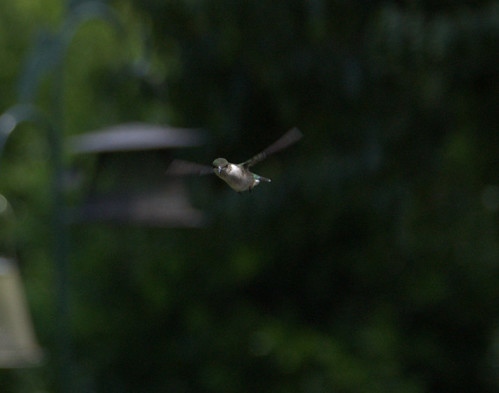
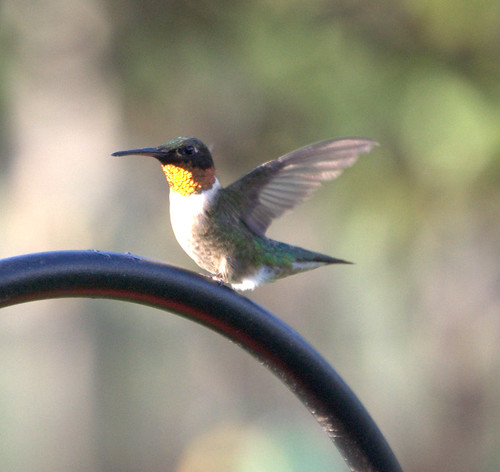
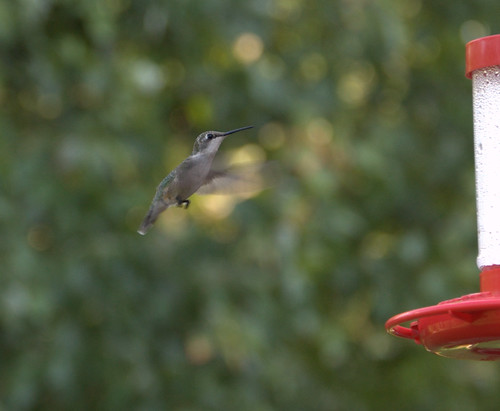
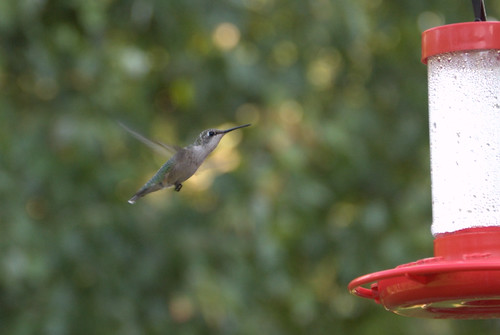
Hummingbird in Flight

The hummingbird (Archilochus colubris) is one popular bird in the garden. We have a couple of regulars around the yard. They seem to like almost any colorful flower in the yard but are especially attracted to the zinnias. I've not only seen them on the zinnias but also the morning glories, the salvias, and even the tomato blossoms. The only reason we put the hummingbird feeder out is to see them up close.


Here he is resting on the feeder. All that flapping must make a hummingbird tired. Can you imagine the calories this little guy uses in a day? The wings can beat anywhere from 40-80 times per second.


For some great information on humming birds check out Hummingbirds.net!

Some Days You Get Rain...

Some days the rain gets you!

Here's one very wet cardinal finishing off the seed from our bird feeder in the rain.

Hummingbirds: In Search of the Elusive Photo of Flight

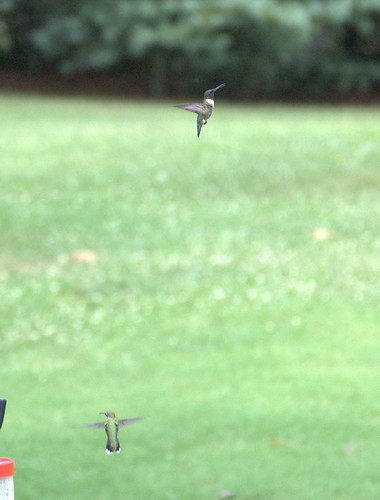
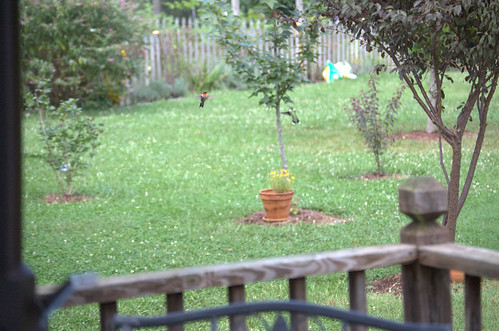
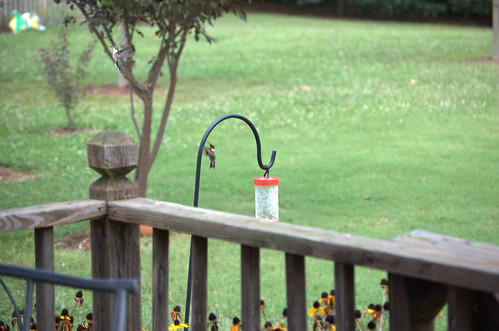
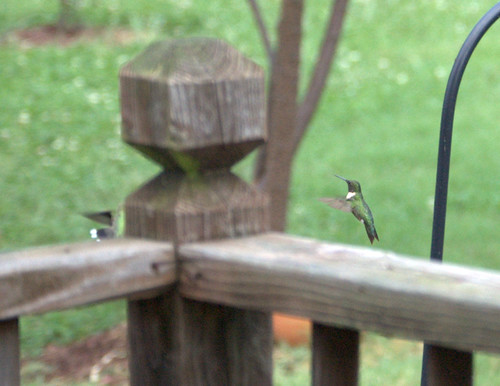
Hummingbirds are one of those subjects that are a challenge to photograph in flight. The best way I've found to get a good shot of a hummingbird is simply to take a whole bunch of pictures. My only other tip is to stake out the bird feeders and wait for that perfect shot while taking multiple pictures per second. The auto focus setting is practically useless since the hummingbirds move like lightning through the air. To capture the hummingbird pictures below I used the manual focus. Out of the 30-40 pictures I took only a couple that I would call "keepers" although several of them are fun shots to look at. The three at the end are the best.

The Dance


The Dance Continues
 

In tandem.


Through the garden.


More Dancing


Acrobatics


Around the pole


"Who's Looking at Me?"


"I'm one handsome bird!"


In Flight


Still in Flight


It was fun following them around with the camera as the 5 or more hummingbirds zoomed through my parent's backyard. Aiming the camera at the birds while attempting to get a well focused shot reminded me of skeet shooting (not that I've ever done it), with a much less destructive outcome! For which I'm sure the hummingbirds are grateful and my parents for that matter, there's no telling how much damage I would do with  a shotgun!