Today I took the mower out for a final spin in the balmy 60 degree weather before closing shop over the winter. I'm sure the mower was appreciative of the action as it had rested in my garage for a month gathering dust. It was a good day. It was just the mower and me, man and machine, making the final cut against the waning weeds and the odoriferous onions. Most of the heat thriving weeds and grasses had faded to that lovely dormant brown color and had given way to the bright green of my fresh cool season Kentucky 31. It's young and thriving, growing strong in the cool fall temperatures!
On we rode, up the slopes and back down again, feeling the rush of the wind on the number two speed setting. Over the bumps we careened like some mechanical bull in a seedy western bar, but the grass was grateful for our passage since in our journey we brought light to the lower levels of the lawn. We chopped down the tall creeping crabgrass and cool weather weeds and allowed the sunlight to stream down upon the young blades of fescue. We rode and we rode until there was only a little more to mow.
The riding mower deserved its rest and so out came his distant cousin the mulching push mower, whose specialty was collecting organic matter for composting. We patrolled the borders of the garden beds looking for rogue weeds and grass threatening to escape the confines of the yard. Once these areas had been successfully contained we moved to the back of the landscape to attack the most serious and threatening invader to new fescue grass in the fall: the leaves. Those paratrooping invaders threatened the well being of any grass unfortunate enough to remain shrouded in the darkness beneath their bulk. Left by themselves to decay the leaves would be a welcome influx of organic matter, but for now they had to be shredded or removed to allow light to reach the small blades of grass. The leaves were sucked into the gaping maw of the push mower and shredded, destined to become an addition to my compost bin. Some of the leaves collected ended up as mulch around trees and others became soil amendments to spots of bare ground plaguing the lawn. Many of these leaves remained where they fell and were summarily shredded. They will serve the ground well as shredded organic matter, improving the soil and giving a helping hand to the fescue that they had previously threatened.
For the mowers it was their final mowdown. The last hurrah before their long winter rest. One last chance to use up their gas and to trim the yard before the cold of winter shut everything down. For me it was one more time to enjoy being outside on a pleasant day.
One more thought:
Leaves are one of the best sources of compost material available. Don't let this resource go to waste. You can pile them up in an unused portion of your property, put them in a compost bin, leave them in place and mow them down into smaller bits. I hate to see people bag up the leaves for roadside collections. Or worse, when they burn them. It's a free resource that will make your landscape better if you use them right!
.

Showing posts with label grass. Show all posts
Showing posts with label grass. Show all posts
Shovel, Rake, and Hoe
The shovel, the rake, and the hoe. Three tools no gardener should be without. Ever. They dig, they grade, and the chop the earth. They cut roots and aid the gardener in tilling when the tiller is kaput. While they take a little muscle to use they are capable of great deeds, such as Bermuda grass removal!
Can you guess what I did on Saturday? If you guessed sipping on a margarita on a cruise ship to Bermuda you aren't anywhere close. I spent the day, yep pretty much the whole day, in the vegetable garden clearing as many Bermuda grass roots as possible. The insidious beasts had hold of a roughly 12' by 18' foot area and were threatening to invade the rest of the garden like Christmas shoppers in the stores on Black Friday. It wasn't pretty.
Simple yes, but also hard back-aching work. Emphasis on the back-aching part. Fortunately the vegetable garden soil is developing into a rich loamy soil with good drainage... all the better for removing those pesky weeds. The hand tool tilling has an added benefit too. When the soil is churned up in the fall insect eggs get exposed to temperatures that don't agree with them. Hopefully it will mean a reduced population of pests for next year.
Here are a few other things I noticed about the Bermuda grass:
While my back isn't too happy with me at the moment I can rest knowing that a major step in the reclamation of the garden has been accomplished. The 2012 garden will be better, much better. There will be Bermuda grass to emerge in the future, I'm sure of it, after all it's like the song that never ends...it goes on and on my friend...
 |
| Raised Bed Vegetable Garden in 2009 |
To remove the Bermuda grass I followed a few simple steps:
- I removed all obstacles that would make the area hard to dig around. That included two raised beds and two trellises.
- I moved all ground covers. In my case it was cardboard that I used to make the garden pathways weed proof. Weed proof is too strong a term, let's just say weed resistant instead...
- Then I dug and sifted, dug and sifted, and repeated. Every sifting brought another knobbly, knotty Bermuda rhizome to the surface. It also brought forth Johnson grass root rhizomes which is another nemesis of my garden.
- I gathered up all the roots and disposed of them in a ditch where they will die from frost exposure.
Simple yes, but also hard back-aching work. Emphasis on the back-aching part. Fortunately the vegetable garden soil is developing into a rich loamy soil with good drainage... all the better for removing those pesky weeds. The hand tool tilling has an added benefit too. When the soil is churned up in the fall insect eggs get exposed to temperatures that don't agree with them. Hopefully it will mean a reduced population of pests for next year.
Here are a few other things I noticed about the Bermuda grass:
- The areas that were covered with cardboard had a very low concentration of Bermuda grass when compared to other areas.
- The Bermuda grass under the cardboard was close to the surface and easier to remove than in the exposed areas.
- A similar situation evolved underneath the tarp I placed earlier in the summer.
While my back isn't too happy with me at the moment I can rest knowing that a major step in the reclamation of the garden has been accomplished. The 2012 garden will be better, much better. There will be Bermuda grass to emerge in the future, I'm sure of it, after all it's like the song that never ends...it goes on and on my friend...
Autumn Seeds: The Bridge To Spring
One of the most interesting things about the fall season is the ability to observe the transformation from lush flowers and foliage to seed heads and dried leaves that flutter on the wind. It's the beginning and the end of two gardening seasons for many plants. The seeds are the bridge that will reach across the gap and bring us a fresh new spring.


 The autumn seeds of an aptly named 'Autumn Joy' Sedum have transformed into chocolate brown seeds. It was well pollinated by the bumble bees and will come back larger each year with a greater display.
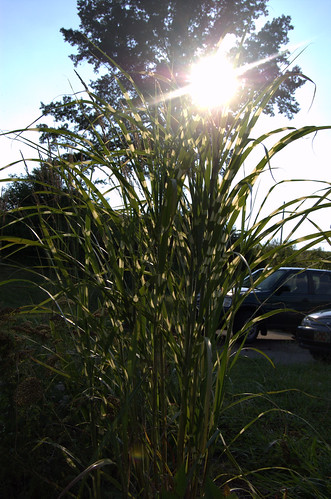
 This Miscanthus sinensis 'Zebrinus' or Zebra grass is back lit by the afternoon sun. The seed plumes of ornamental grasses are one its most valuable features. It pains me to see
  ornamental grasses pruned short in the fall (as is commonly done in commercial landscapes) when their winter interest is so great. If you want winter interest ornamental grasses are a very good way to go.
The birds are just as likely to enjoy the seed heads of the rudbeckia as we are. The seeds will self sow each year bringing more plants and consequently more flowers. This particular plant thrived in our rain garden which helps to absorb the excess water from our driveway. I planted a few plants into it but mostly allowed zinnias and rudbeckias to take over by sprinkling seed in the spring. I have plans to improve it for next year but I'll save that for another time!

 Here's an interesting specimen. I was pulling out the dead basil and dropped it temporarily into a large pot that was nearby. Rather than move it to the compost bin I thought I would leave it for a while to add some contrast to our winter landscape. Even though it's brown and dead it gives the eye something to gaze upon when everything is bare.
 Miscanthis Sinensis Tassels Waving in the Wind
Though it is listed in the invasive plants list for Tennessee the very quality that makes Miscanthis sinensis so invasive makes it fun to have in the garden, the seeds! Ornamental grasses of all kinds add great fall color interest with their seed heads or tassels that wave in the wind. This particular variety is 'Zebrinus' or Zebra grass.

If you are looking for a nice substitute for miscanthus that is also a native try switch grass (Panicum virgatum). I've added two switchgrass varieties this year to the gardens: 'Shenandoah' and 'Northwind'. Both of which are worthy plants in the landscape but are a little different in appearance than miscanthus. 'Shenandoah' has a nice reddish tint to its late summer and fall foliage with clouds of seeds. 'Northwind' is a strong upright plant with green foliage and airy seed heads. 'Shenandoah' is in our back garden near the greenhouse and 'Northwind' is near our mailbox garden (May 2008, August 2009).
Have you added any new grasses to your garden this year?
Raindrop Garden Photography
Rain has been ever present in our garden for the last two weeks it seems. Even the "dry" days are still wet when you consider the soggy ground and grasses you have to walk through to get anywhere. Today I thought I would share a couple pictures that are enhanced by the rain.
Raindrops on Clover
Clover is one of those "lawn weeds" that I actually like having around. It's green during the cool season, it adds nitrogen into the soil which in turn feeds the grass, and it gives the bunnies something to eat other than my plants!


Raindrops on Clover
Clover is one of those "lawn weeds" that I actually like having around. It's green during the cool season, it adds nitrogen into the soil which in turn feeds the grass, and it gives the bunnies something to eat other than my plants!


Raindorps on Muhlenbergia capillaris
The third picture is of raindrops that have collected on the seed heads of our Muhly Grass (Muhlenbergia capillaris). It's a great native ornamental grass for the fall garden. The reddish tinted seed heads put on a fantastic display when planted en mass like Frances planted them. The raindrops in this photo almost appear to be little gems congregating on the end of the plant.

What was the most interesting photograph of the raindrops in the garden that you've taken?
Rambling on Lawn Grass
When sowing grass seed timing is everything. The right grass planted at the right time works wonders for a lawn, but the reverse can be true as well. Here in Tennessee we live in an a rather ambiguous area for growing grasses. The cool season grasses do great - that is until it gets hot and they turn all brown. The warm season grass like Bermuda do great too - only they turn brown in the cool fall temperatures and pretty much stay a lovely, drab carpet of brown until things warm up again. So here in Tennessee we just have to accept the fact that lawn grasses are limited and we have to work around that.
Each fall I take a few steps to ensure a nice lawn in the spring. OK really I take one step I - overseed. I would like to say I do everything I'm supposed to do for my lawn but I tend to dedicate my time in other areas. I should aerate the soil with a plugger but I never get to that. I used a spiker aerater once before but it really didn't do the best job in the world. I don't use winterizers in my lawn. I have an aversion to using chemicals in the landscape in general. The chemicals have to go somewhere and more and more studies are finding trace elements of junk in our water systems from fertilizers to medicines. I'll do what I can to avoid adding to the problem because well, I really do like to drink water...
My solution to adding extra nitrogen to the soil is planting a cover crop alongside my normal fall grass seeding. After I broadcast spread the Kentucky 31 today I went back over it with good old annual Rye grass I bought from my local Coop. Annual Rye grass can add somewhere between 30-90 lbs. of nitrogen per acre back to the soil after its growth cycle is complete. The other cool thing about Rye grass that I read in a Rye Grass Management Guide on the Oregon Grown Ryegrass Covercrop Webpage (yes there is a such thing - there seems to be a website for everything these days!) is that Rye grass does great job of breaking up the soil with its roots. Its root systems can grow three to four feet into the soil. When the roots dye back it leaves behind tiny holes and pathways called macropores. Plants that follow the ryegrass can send their roots down deep through those macropores and get easy access to moisture deep in the soil. With our heavy clay Tennessee soil anything that breaks it up is beneficial!
To sum things up here's what I do for my lawn:
What I don't do for my Lawn:
That's the basics of lawncare in my world. You don't have to chemicalize your garden. I don't go all out and honestly I'm happy with less!

Each fall I take a few steps to ensure a nice lawn in the spring. OK really I take one step I - overseed. I would like to say I do everything I'm supposed to do for my lawn but I tend to dedicate my time in other areas. I should aerate the soil with a plugger but I never get to that. I used a spiker aerater once before but it really didn't do the best job in the world. I don't use winterizers in my lawn. I have an aversion to using chemicals in the landscape in general. The chemicals have to go somewhere and more and more studies are finding trace elements of junk in our water systems from fertilizers to medicines. I'll do what I can to avoid adding to the problem because well, I really do like to drink water...
My solution to adding extra nitrogen to the soil is planting a cover crop alongside my normal fall grass seeding. After I broadcast spread the Kentucky 31 today I went back over it with good old annual Rye grass I bought from my local Coop. Annual Rye grass can add somewhere between 30-90 lbs. of nitrogen per acre back to the soil after its growth cycle is complete. The other cool thing about Rye grass that I read in a Rye Grass Management Guide on the Oregon Grown Ryegrass Covercrop Webpage (yes there is a such thing - there seems to be a website for everything these days!) is that Rye grass does great job of breaking up the soil with its roots. Its root systems can grow three to four feet into the soil. When the roots dye back it leaves behind tiny holes and pathways called macropores. Plants that follow the ryegrass can send their roots down deep through those macropores and get easy access to moisture deep in the soil. With our heavy clay Tennessee soil anything that breaks it up is beneficial!
To sum things up here's what I do for my lawn:
- Overseed fescue in the fall
- Alternate different varieties of fescue each fall.
- Plant Ryegrass in the fall
- Cut the grass high (helps the roots grow deeper, and prevents weed seeds from getting the light they need to germinate.)
What I don't do for my Lawn:
- Fertilize with inorganic fertilizers - it does get grass clippings (and recently lots of bunny droppings!). Grass clippings put back up to 4 percent nitrogen. According to this grass clippings can provide 25% of the nitrogen the lawn needs. I have been tempted to add corn gluten in spring which also has the added benefit of being a pre-emergent weed suppressant as well as a nitrogen fertilizer. My fertilizing habits have been minimal and my lawn seems to do good enough for me. Granted it's not a golf course - but I don't play golf and trust me - you don't want to see me try! Chemical fertilizer also contain salts that can over time make your soil less fertile.
- I don't use herbicides on the lawn. I like the clover which also adds nitrogen and is food for pollinators like bees. Keep the clover. It's a good plant - really - it is! I heard on the radio a while back that many years ago clover wasn't considered a weed and it wasn't until broadleaf herbicides were developed that it began to get a bad rap. Companies began marketing those herbicides and started calling clover a weed because the herbicide happened to kill it too. Makes sense right? Change perception to make your product more acceptable. Clover gradually became considered a weed when it really ought to be enjoyed for its benefits. I can't verify that radio information but it wouldn't surprise me if it were true. I actually over seeded some areas with red clover this year - yep I like clover. You should too!
- I don't aerate but probably should every now and then.
- I don't plant Bermuda grass. It's the worst thing for creeping into garden beds you can imagine. OK maybe not there are a few things I could list that are worse - much worse- but you gotta admit Bermuda in a garden isn't a good thing!
That's the basics of lawncare in my world. You don't have to chemicalize your garden. I don't go all out and honestly I'm happy with less!
Muhly Grass (Muhlenbergia capillaris)
I finally found some Muhly grass (Muhlenbergia capillaris) to add to the garden. It's been on my radar for a while and it was even more desired after seeing it in such impressive displays at Frances' Garden! Yesterday I planted it in our Japanese maple garden next to the Miscanthus sinensis 'Morning Light' that I had already planted. The miscanthus will be moved later but the muhly grass will stay. I like the combination of the pinkish seed heads with the red foliage of the Japanese maple (Acer palmatum). Whenever I buy a plant I look to see if I can sneak a few more out of the pot. Call me cheap, frugal, or whatever you want I like getting more plants for my money! With the Pink muhly grass I was able to get two sizable plants and one little offshoot. I made the division with a shovel and one little sprig of grass fell loose (grasses are not supposed to be divided in the fall, just call me a rebel - spring is much safer!). I decided to pot it up since it had roots attached to hopefully make a new one for next year. With a plant this attractive who wouldn't want more?

It's a great plant for fall color!

It's a great plant for fall color!
Edit: I later purchased two more Muhly grass plants from a mailorder nursery and was disappointed with the size and the shipping of that company. For that reason I do recommend trying to find it at a local nursery before ordering it through the mail. By comparison the nursery Muhly had 2-3 more years growth on it than the mailorder and was only a little more expensive. Of course if you can't find it locally go for the mailorder - better a small Muhly than no Muhly!
It Is Most Definitely Fall

When I was still teaching (before I became a stay at home dad) we lived in the foothills of the Smoky Mountains and let me tell you that that area is one of the most beautiful places for fall scenery. I didn't get to hike in the Smokies as much as I would have liked (too many school duties on the weekends, yep on the weekends) but when we did the fall foliage was spectacular.
Since those days I've tried to fill my garden with plants that will give us that sense of brilliant fall color. Now every fall I check the progress of my plantings as they grow and become larger focal points of fall color. I've planted maples, lots of maples. 'Red Sunset' was our first maple planting but other red maples (Acer rubrum) have followed including a 'Brandywine' and three non-named maples. Japanese maples have been planted too including 'Sango Kaku' and two others. I also have several Japanese maples that were grown from seed but haven't been planted in the ground yet. Crape myrtles also provide a good amount of fall color.
The native trees around us provide most of our fall color. Sassafras, maples, oak, and hackberry trees are all common around here and frame our yard. They give us the impression that we are all alone in our yard, at least until the leaves drop and we can again see our neighbors. I would love to have a nice stand of pine trees just on the other side of all our deciduous trees!
 |
| 'Shasta' Viburnum Fall Color |
 |
| 'Shenandoah' Switchgrass |
I've planted a lot of trees and shrubs but grasses are great for fall and winter interest. I have a definite preference for the switchgrasses since they are native. If you don't worry about planting natives switchgrasses are spectacular choices anyway. 'Shenandoah' is my fall color favorite with its beautiful red hues but the garden also has 'Heavy Metal', 'Northwind', and soon will have a few more varieties.
It's a fun time of year to be a gardener. It's almost as if the fall foliage becomes a canopy of flowers. The colors are changing and it is most definitely fall!
Are you looking forward to the slower pace of gardening in the offseason?

Organic Removal of Bermuda Grass
Last weekend I pulled out the tomato plants (all but three) and did the yearly Bermuda grass removal. Bermuda grass is one of the two most frustrating parts of my vegetable garden, the other being the deer. Bermuda grass (Cynodon dactylon) grows and spreads through rhizomes (under the soil) and stolons (above the soil). Any piece of the roots or stolons left behind will regrow which makes removing Bermuda grass very difficult.
 To remove the Bermuda grass I use a trimmer and cut back all the grass to the ground. Then I till up the soil multiple times. After each run with the tiller I rake up the roots and stolons for collection and dump them. The remains never go in the compost bin as all it takes is one little piece of uncomposted Bermuda grass to wreak havoc later. I repeat the process until as much of the grass is out as possible. It will come back, but this process makes a major dent in it. The disadvantage of this method is that the tiller cuts the Bermuda grass into smaller pieces which can resprout. In the spring before planting I'll need to repeat the process and then again in the fall. This probably will not eliminate it but should keep it under control. Every piece of Bermuda grass root that is removed will mean a smaller problem later.
Another method for removing Bermuda grass involves completely removing the soil. To do that you need to remove at least 6 inches of soil to be sure all the roots are accounted for. That is a lot of soil to remove so I prefer to use the tilling method to leave the majority of the soil in place.

A third method to remove Bermuda grass is to smother it. Multiple layers of cardboard covered with a good 6 inches of mulch then left in place undisturbed for several weeks to even months. For me this isn't a good option since I would then need to leave the area unplanted for too long.
Solarizing is another method. A plastic sheet can cover the area which increases the heat underneath and reduces moisture in the soil which will eventually kill off Bermuda grass. Solarizing Bermuda grass can take several weeks to accomplish.

The best strategy is probably a combination of all the above methods. Unfortunately seeds from Bermuda grass can cause another round, as can a small sprig of grass mowed in from the lawn or dropped by a nest building bird. Keep your garden well mulched where you can and be as aggressive as the Bermuda grass in your fight!
Another method for removing Bermuda grass involves completely removing the soil. To do that you need to remove at least 6 inches of soil to be sure all the roots are accounted for. That is a lot of soil to remove so I prefer to use the tilling method to leave the majority of the soil in place.
Solarizing is another method. A plastic sheet can cover the area which increases the heat underneath and reduces moisture in the soil which will eventually kill off Bermuda grass. Solarizing Bermuda grass can take several weeks to accomplish.
The Miscanthus and the Big, Big Sky
Picking a photo for Gardening Gone Wild's Photo monthly contest was a challenge. The subject matter for September is ornamental grasses. I took photos of the grass leaves, the seed heads, and from different perspectives and finally settled on the first picture of the Miscanthus sinensis 'Zebrinus'. I liked the second picture of the seedheads because of the similar orientation of the seedheads.
Miscanthus and the Big, Big SkyMiscanthus sinensis 'Zebrinus'I like the arcing blades of grass in front of the blue sky and the clouds in the background. What do you think? Does the cloud in the sky resemble a man with a beard?Feel free to click on the picture for a larger view if you need to!

Synchronized SwayingMiscanthus sinensis 'Zebrinus'The wind was blowing the seedheads back and forth. What I found interesting was the synchronicity of the grass seeds.


Dave's Chores for the Garden Addendum
I realized today that I left off a very important chore that I'll need to do very soon, grass overseeding!
Fall Grass Overseeding. I need to spread grass seed over our existing lawn. Last year I used Kentucky 31 fescue and our lawn looked great in the spring. It browned up over the summer since fescue is a cool season grass but it's greening up again now that the rains have come back and the temperatures are slightly cooler. I want to put a combination of grasses into our yard so this year I'll find something other than Kentucky 31. A rye grass would be good for winter greening but most likely wouldn't make it until next year. I don't want Bermuda grass anywhere in our yard, ever. Once it finds it's way in it is hard to get rid of especially when it comes to garden beds. I'll probably go with another fescue variety. Perhaps there is a fescue that is more drought tolerant. I don't water my grass and it would be nice if it stayed green longer.
Fall Grass Overseeding. I need to spread grass seed over our existing lawn. Last year I used Kentucky 31 fescue and our lawn looked great in the spring. It browned up over the summer since fescue is a cool season grass but it's greening up again now that the rains have come back and the temperatures are slightly cooler. I want to put a combination of grasses into our yard so this year I'll find something other than Kentucky 31. A rye grass would be good for winter greening but most likely wouldn't make it until next year. I don't want Bermuda grass anywhere in our yard, ever. Once it finds it's way in it is hard to get rid of especially when it comes to garden beds. I'll probably go with another fescue variety. Perhaps there is a fescue that is more drought tolerant. I don't water my grass and it would be nice if it stayed green longer.
3 Chores to Do in Fall for Spring!
It's that time of year again, time to think about spring! Yes, I said that right. Spring! Fall is almost here but if you want to maximize the potential of your garden next year fall is the best time to get some work done. The autumn leaves will be changing soon and now is the best time to get some garden preparation accomplished in the cooler weather. What preparations can you do in fall for a good spring garden?
 Mulching your garden beds is one of the best things you can do for your perennials and trees. Mulch insulates the soil from the cold weather can help borderline plants overwinter better. It also protects the soil from compaction and adds organic matter to the ground over time. Cover each bed with a two inch layer of the mulch of your choice for good protection.
 Fall overseeding is an essential part of lawn care. I'm not a overzealous lawn fanatic by any means but I do enjoy having a nice open space for my kids to play. I want my lawn to look good but not be overly reliant on treatments. Each fall I overseed with a new bag of grass seed. I vary what type of grass I use each year to create some diversity in the lawn. I make efforts to grow my lawn as organically as possible which means certain cultural treatments are necessary including overseeding in the fall, mowing the correct height, and accepting and allowing diversity (yes that means a few weeds!). Often weeds like clover and dandelion can be beneficial to your lawn and garden.
Fall is an awesome time to plant. Trees and shrubs planted in the fall get a head start on building root systems for next spring. The soil stays warmer longer than the air and the roots will continue to grow for a little while until it gets too chilly. Bulbs love to be planted in the fall! Some bulbs need a certain length of time in the cold called "chill hours." Once bulbs receive the correct amount of time they will send up shoots through the soil to gather energy and eventually produce flowers. Daffodils are an excellent bulb for any garden and have always demonstrated a high degree of deer and rabbit resistance in my garden. Tulips look great but do not last nearly as well as daffodils. Often tulips need replanted each year as they are a delicacy for voles and chipmunks. Tulips need to gather enough energy through the spring to store and resprout in the following year so leave the leaves up until they begin to turn brown if you want a repeat performance!
Fall is the best time of year to do many of the garden tasks that need done. It's also my favorite time of year since the weather is cooler and it is so much more enjoyable to be outdoors. So many people dread those chores but I love the fall leaf cleanup (free mulch collection) and dreaming about the potential for spring gardening! What is you favorite season in the garden?
(All supplies pictured in this post were provided by Lowe's through Lowe's Creative Ideas!)
Mulch in the Fall
Mulching your garden beds is one of the best things you can do for your perennials and trees. Mulch insulates the soil from the cold weather can help borderline plants overwinter better. It also protects the soil from compaction and adds organic matter to the ground over time. Cover each bed with a two inch layer of the mulch of your choice for good protection.Overseed Grass in the Fall
Plant Trees, Shrubs, and Bulbs in the Fall
Fall is an awesome time to plant. Trees and shrubs planted in the fall get a head start on building root systems for next spring. The soil stays warmer longer than the air and the roots will continue to grow for a little while until it gets too chilly. Bulbs love to be planted in the fall! Some bulbs need a certain length of time in the cold called "chill hours." Once bulbs receive the correct amount of time they will send up shoots through the soil to gather energy and eventually produce flowers. Daffodils are an excellent bulb for any garden and have always demonstrated a high degree of deer and rabbit resistance in my garden. Tulips look great but do not last nearly as well as daffodils. Often tulips need replanted each year as they are a delicacy for voles and chipmunks. Tulips need to gather enough energy through the spring to store and resprout in the following year so leave the leaves up until they begin to turn brown if you want a repeat performance!
Fall is the best time of year to do many of the garden tasks that need done. It's also my favorite time of year since the weather is cooler and it is so much more enjoyable to be outdoors. So many people dread those chores but I love the fall leaf cleanup (free mulch collection) and dreaming about the potential for spring gardening! What is you favorite season in the garden?


A Sunday Question: What are the Best Ornamental Grasses in Your Garden?
 Here's another question for another Sunday! What are the best ornamental grasses in your garden? Ornamental grasses are great plants to use whether as a background or as a feature plant. There are all kinds of ornamental grasses to choose from; some are native and some exotic. In our garden we only have two varieties but I hope to add more eventually. The two we have are Miscanthus sinensis 'Zebrinus' (a variegated miscanthus) and Karl Foerster 'Feather Reed Grass' (Calamagrostis x acutiflora).
The striped pattern on the miscanthus makes it very interesting in the garden as a foliage plant. Miscanthus sinensis actually comes from China. Generally anything that has sinensis in its botanical name comes from China. I have two clumps of it in our Bird Bath Garden (Bird Bath Garden Layout).
The Karl Foerster Feather Reed Grass has been a little on the disappointing side. It is a great grass to add into any garden but I divided it shortly after purchasing it last fall and it is still recovering. It will do fine eventually but for now the three clumps are a bit on the small side. Time will heal all wounds and next year they should be pumped up and ready to grow! I have it in our rain garden mixed together with rudbeckia and zinnias. Feather reed grass would look great with coneflowers and other wildflowers, which coincidentally are in the rain garden also!
There's a list of grasses I would love to have growing in my garden but at the top of my list is Muhly grass (Muhlenbergia capillaris). I actually like the pink variety of it better than the white mainly for the color interest, but both would add some value to a garden. Muhly grass is a native grass found from Texas on northward to Massachussets that grows to about 3 feet tall.
What ornamental grasses to you have in your garden? And/or what ornamental grasses do you want to add to your garden?
Time to Blitz the Bermuda!
Every gardener has an enemy, a nemesis, an evil villain that lurks in the garden that the garden would love to eradicate. I've had an invader this year that has been more aggressive than ever before - Bermuda grass. Once it gets a foothold in the garden it is extremely hard to hold back, let alone eliminate. Recently I attempted to use an EcoSmart non-selective herbicide on the Bermuda grass. While it browned the leaves it did very little lasting damage and the Bermuda grass came back easily within a few days. Bermuda grass 1, Dave 0. This weekend I began a second assault on the Bermuda grass. It's another extension of my very successful TARP for gardening program from a while back.
I laid the tarp down over the infected area in order to bake the Bermuda to a crisp. Let's hope this works!

Hopefully the heat and lack of light will weaken the Bermuda and even kill it off. If any root remains alive I know it could easily come back so after I remove the tarp I'll double dig the area and try to take out any roots I find.
I laid the tarp down over the infected area in order to bake the Bermuda to a crisp. Let's hope this works!

Hopefully the heat and lack of light will weaken the Bermuda and even kill it off. If any root remains alive I know it could easily come back so after I remove the tarp I'll double dig the area and try to take out any roots I find.
What strategy have you used effectively against Bermuda grass?
A Switchgrass Followup
In yesterday's post on propagating switchgrasses I left out the picture of the 'Northwind' Switchgrass (Panicum virgatum). Also I didn't post any details about the two switchgrasses that I mentioned. So here's a little more about switchgrasses!
Switchgrasses are native to the United States and flourish during the warm season. In my observations they are later to emerge from winter dormancy than other grasses like miscanthus. 'Shenandoah' Switchgrass grows between 3 and 4 feet tall and is one of the shorter varieties of panicum available for ornamental use. The two 'Shenandoah' switchgrasses I have in our backyard gardens are different sizes even though the plants started out the same. The taller of the two fits in the between 3 and 4 foot range but the other one is much shorter and also has a smaller width. I believe this is due to the sun conditions which favor the larger 'Shenandoah'. It receives about 1.5 to 2 hours more of natural sunlight than its companion. The more sun the switchgrass receives the more vigorous it grows.
The 'Northwind' switchgrass is near the road in the mailbox garden (which really needs some work!) It gets full sun but has grown as tall as they say mostly because of the hard compacted clay soil where it is growing. The roadside area is one of the worst spots in our yard to grow plants because when our community was created some areas were completely scraped of any soil during the grading process. What was left was the clay and gravel leftover from construction. I've gradually added mulch and compost to the area but "Rome wasn't built in a day"! The poor soil doesn't prevent this switchgrass from performing well but does keep it from its potential. 'Northwind' should grow between 4 and 5 feet tall but our second year plant is just a little over three feet in height. As the soil loosens, compost is added and rain resumes conditions should improve for my 'Northwind'.
One switchgrass that is on my radar is 'Prairie Fire' which resembles a 'Shenandoah' on steroids. The red coloring that emerges in summer seems much deeper and darker than 'Shenandoah'. It's height varies depending on where you look and could be anywhere between 3-6 feet (according to Fine Gardening Magazine). I haven't seen it sold near me yet but I'll be on the lookout!
Switchgrasses are native to the United States and flourish during the warm season. In my observations they are later to emerge from winter dormancy than other grasses like miscanthus. 'Shenandoah' Switchgrass grows between 3 and 4 feet tall and is one of the shorter varieties of panicum available for ornamental use. The two 'Shenandoah' switchgrasses I have in our backyard gardens are different sizes even though the plants started out the same. The taller of the two fits in the between 3 and 4 foot range but the other one is much shorter and also has a smaller width. I believe this is due to the sun conditions which favor the larger 'Shenandoah'. It receives about 1.5 to 2 hours more of natural sunlight than its companion. The more sun the switchgrass receives the more vigorous it grows.
The 'Northwind' switchgrass is near the road in the mailbox garden (which really needs some work!) It gets full sun but has grown as tall as they say mostly because of the hard compacted clay soil where it is growing. The roadside area is one of the worst spots in our yard to grow plants because when our community was created some areas were completely scraped of any soil during the grading process. What was left was the clay and gravel leftover from construction. I've gradually added mulch and compost to the area but "Rome wasn't built in a day"! The poor soil doesn't prevent this switchgrass from performing well but does keep it from its potential. 'Northwind' should grow between 4 and 5 feet tall but our second year plant is just a little over three feet in height. As the soil loosens, compost is added and rain resumes conditions should improve for my 'Northwind'.
 |
| 'Northwind' Switchgrass (Panicum virgatum) |
Seven (More) Switchgrasses
Today I potted up seven rooted sections of switchgrass (Panicum virgatum). Four of them were 'Shenandoah' which gains a reddish coloring in the leaves in late summer and fall and three were 'Northwind' which has a taller and more upright shape. Switchgrasses are definitely "where it's at" when it comes to ornamental grasses today. They are native plants and aren't invasive. To make things even more perfect ethanol producers have been using switchgrass as a substitute for corn to produce biofuels. Not a bad plant by any means! Because it's a native it is well adapted to our weather and should be able to survive random periods of drought like we've been having lately. (Only .3 of an inch in the last two weeks - not fun for the gardener or the garden!)
Since these are such great plants to have in the garden I decided to increase my stock of switchgrass by what else? Propagation!
 Propagating Switchgrass is very easy through division. The exact method of division depends on the size plant I want. If I want smaller plants that don't effect the size of the mother plant I take pieces from the outside of the clump, move the soil away, and remove a stem with roots with a sharp knife (or a good yank - but sometimes the roots don't come and the stem separates at the nodes). This is very easy to do and you can make many (albeit small) divisions. These switchgrass divisions are now potted up individually where I will grow them until they have grown a large enough root system to be planted in the yard. Hopefully I'll have the time to make a few more divisions later in the week.
 Now if I want larger clumps I would dig up the whole clump and use a shovel to slice through the entire root system. This method will produce about 4 (sometimes more) decent sized clumps from a large switchgrass. It's more labor intensive than the first method but gives you a larger clump faster. The first method can be done nearly anytime since it isn't very invasive but I wouldn't even consider doing the second method (digging up the clump) unless it was early in the year when we were still receiving rain and the new growth was fairly short. Early spring is probably the best time to divide a large clump.
Have you added switchgrass to your garden?
Since these are such great plants to have in the garden I decided to increase my stock of switchgrass by what else? Propagation!
 |
| 'Shenandoah' Switchgrass (Panicum virgatum) |
How to Propagate Switchgrass

 Now if I want larger clumps I would dig up the whole clump and use a shovel to slice through the entire root system. This method will produce about 4 (sometimes more) decent sized clumps from a large switchgrass. It's more labor intensive than the first method but gives you a larger clump faster. The first method can be done nearly anytime since it isn't very invasive but I wouldn't even consider doing the second method (digging up the clump) unless it was early in the year when we were still receiving rain and the new growth was fairly short. Early spring is probably the best time to divide a large clump.
Have you added switchgrass to your garden?
The Rain Garden Photos
Early last year I put together a rain garden in our yard to absorb some of the driveway drainage. Here are a few pictures of how it looks now!
Inside the garden we have a variety of perennials that are generally carefree and tolerate a wide range of growing conditions. Plants like coneflowers. Echinacea purpurea is having a perfect year here in our garden.

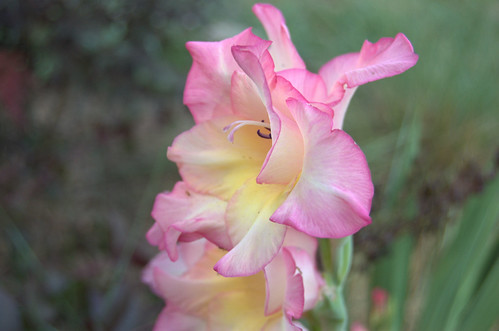
If we change our focus a little we can view the gladiola. One of the few summer blooming bulbs I've added to the gardens. They look really nice when they stand upright but have a terrible tendency to topple toward the turf! Those little green bamboo stakes would be good to help stake them up if necessary.

The pale pink blends nicely with the purple of the coneflowers but the gladiolas look great all by themselves as well.

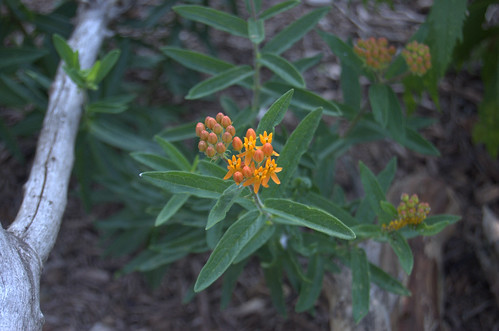
Asclepias tuberosa or orange butterfly weed is a fantastic, easy care perennial. It doesn't transplant very well due to the large tuber so if you decide it needs to be moved you had better move much of the dirt around the roots as well. You'll see butterfly weed growing along roadsides and it grows readily from seed planted directly in the garden.


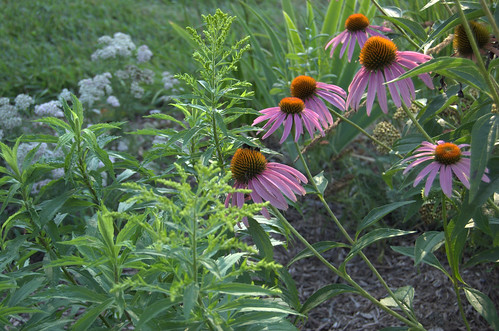
Here you can see the golden rod's placement next to the coneflowers. It should look very neat with the purple and gold colors blending together in the late summer raingarden.

One of the two kinds of ornamental grasses in the raingarden is Miscanthus sinensis 'Zebrinus' also known as Zebra grass. I took advantage of the setting sun to capture some back lighting for the photo. You can really see the variegation in the leaves of grass.

Due to Garden Blogger's Bloom Day on Wednesday (and poor planning on my part) I'm delaying Worst Weed Wednesday until July 29th. Wednesday July 22nd isn't an option since I'll be unavailable for blogging that day. I'll post a reminder toward the end of next week!
Inside the garden we have a variety of perennials that are generally carefree and tolerate a wide range of growing conditions. Plants like coneflowers. Echinacea purpurea is having a perfect year here in our garden.

If we change our focus a little we can view the gladiola. One of the few summer blooming bulbs I've added to the gardens. They look really nice when they stand upright but have a terrible tendency to topple toward the turf! Those little green bamboo stakes would be good to help stake them up if necessary.

The pale pink blends nicely with the purple of the coneflowers but the gladiolas look great all by themselves as well.
Asclepias tuberosa or orange butterfly weed is a fantastic, easy care perennial. It doesn't transplant very well due to the large tuber so if you decide it needs to be moved you had better move much of the dirt around the roots as well. You'll see butterfly weed growing along roadsides and it grows readily from seed planted directly in the garden.
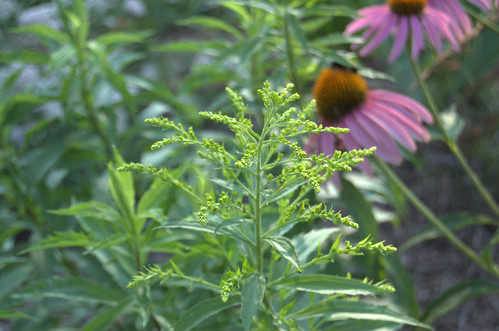
It's not blooming yet but this ornamental golden rod (aren't they all?) is beginning to bud. Over the years varieties of golden rod (Solidago) have been bred to grow as shorter heights with different flowers than what we normally see in the wild. Unfortunately many people don't see the value of golden rod in the landscape as they get it confused with a more infamous plant: ragweed. Both plants blooms at the same time and golden rod gets blamed for the allergy problems associated with ragweed. Golden rod is insect pollinated while ragweed is wind pollinated.
Here you can see the golden rod's placement next to the coneflowers. It should look very neat with the purple and gold colors blending together in the late summer raingarden.
One of the two kinds of ornamental grasses in the raingarden is Miscanthus sinensis 'Zebrinus' also known as Zebra grass. I took advantage of the setting sun to capture some back lighting for the photo. You can really see the variegation in the leaves of grass.
Due to Garden Blogger's Bloom Day on Wednesday (and poor planning on my part) I'm delaying Worst Weed Wednesday until July 29th. Wednesday July 22nd isn't an option since I'll be unavailable for blogging that day. I'll post a reminder toward the end of next week!
Close Ups in the Bird Bath Garden
Here is one of our coreopsis plants with it's blooming like dozens of little yellow and red suns. I've recently discovered two small pots that have between 10-15 coreopsis seedlings in each of them. The rain garden I built will probably be a recipient of several as will the vegetable garden perennial ring.

And a close-up picture with some rain drops appearing from our recent rains. These are great plants, full of blooms and drought hardy. If you like yellow plants that need little care then you have your candidate!

Here is our Echinacea purpurea. I think I can confirm now that it is a 'Sunset' variety. I like the unique peachy color of this coneflower with its normal looking petals. I don't really like the double mutant forms that are available, they look like alien plants to me.

This coneflower has quite a few buds for us to enjoy. I'm really looking forward to watching its progress over the summer. Our 'Sunset' coneflower has given us three volunteer seedlings in our birdbath garden. I like little surprises like that!

Miscanthus sinensis 'Zebrinus'. I took a close-up shot to show the variegated foliage. It will grow quite large but I plan to divide it each spring to make more plants. The large ornamental grasses can make a good privacy screens if you have enough plants to plant in a row. If you want to divide ornamental grasses it's a good idea to do it when the plant is about a year old otherwise you might need heavier equipment than a shovel!


And a close-up picture with some rain drops appearing from our recent rains. These are great plants, full of blooms and drought hardy. If you like yellow plants that need little care then you have your candidate!

Here is our Echinacea purpurea. I think I can confirm now that it is a 'Sunset' variety. I like the unique peachy color of this coneflower with its normal looking petals. I don't really like the double mutant forms that are available, they look like alien plants to me.

This coneflower has quite a few buds for us to enjoy. I'm really looking forward to watching its progress over the summer. Our 'Sunset' coneflower has given us three volunteer seedlings in our birdbath garden. I like little surprises like that!

Miscanthus sinensis 'Zebrinus'. I took a close-up shot to show the variegated foliage. It will grow quite large but I plan to divide it each spring to make more plants. The large ornamental grasses can make a good privacy screens if you have enough plants to plant in a row. If you want to divide ornamental grasses it's a good idea to do it when the plant is about a year old otherwise you might need heavier equipment than a shovel!

5 Plants I Really Like!
Fads come and go and garden fads do the same thing. What I like today might be different in 10 years, 5 years, or even 1 year! But for this Friday Five post I thought I'd tell you a little about the plants I really like right now. While this list contains some specific plants it also contains a types of plants (some of which may only be loosely related.)
- Heucheras are the "in" plant of today or at least I think so! They are an American native plant that thrives in dry shade areas. Heucheras are perennial plants that need occasional dividing every 3-4 years. They grow outward and eventually leave an open center section that can be covered back up with soil and encourages to grow back. I prefer dividing them in the spring time by digging the plant up and separating the rooted sections into individual plants with pruners. They don't divide as easily as daylilies or hostas might but can be successfully propagated through division. There are many neat varieties to try and more are being made every year. I added 'Paris' and ' Georgia Peach' to our corner shade garden this year. We also have 'Mocha', 'Katelyn', 'Southern Comfort', 'Dale's Strain', 'Palace Purple', 'Mystic Angel' and a few others.

- Switchgrasses are the awesome alternative to miscanthus which has become invasive in many states. Switchgrasses are native grasses that provide nesting locations for ground nesting birds and other wildlife but they also make a fantastic ornamental grass! 'Northwind' is a good upright bluish colored switchgrass as is 'Heavy Metal'. I'm a big fan of 'Shenandoah' for its fall color.

- Hostas have been a garden favorite of many gardeners for many years and continue to be one of my favorites! I've been hosta challenged over the years with a garden that has little shade and hosta predators like deer and rabbits. The shade situation is better now but there's no getting rid of the deer and rabbits. Creatively interplanting hostas with heucheras has helped as the deer and rabbits are not terribly fond of huecheras. Hellebores aren't something deer or rabbits eat either and make good companion plants for hostas.
- Native Plants are becoming increasingly popular these days for good reason. Native plants do better in our climate since they have adapted to live here over the centuries. They are capable of growing in our challenging soils and take the heat and humidity better than many exotics. I'm trying to add more and more native plants to our garden as I go which I think makes my job as a gardener a whole lot easier! This year I added a red buckeye to the garden near the shed. It's a small tree/shrub that gets beautiful red tubular flowers that attract hummingbirds.
Viburnums have always been a favorite shrub of mine. Flowers in the spring, followed by berries in the late summer, and some pretty neat fall colors make viburnums a great choice in any garden. Some can get quite large and once they get started are very strong performers. My newest viburnum is 'Onondaga' which I just planted a couple weeks ago. I can't wait to see how it does in our garden. The lacecap type flowers are very similar to many hydrangeas.
'Shasta' Doublefile Viburnum


Now it's your turn! What five plants are your favorites?
Write a post on it if you feel so inclined!