.

Showing posts with label Books. Show all posts

The Magic Gardener


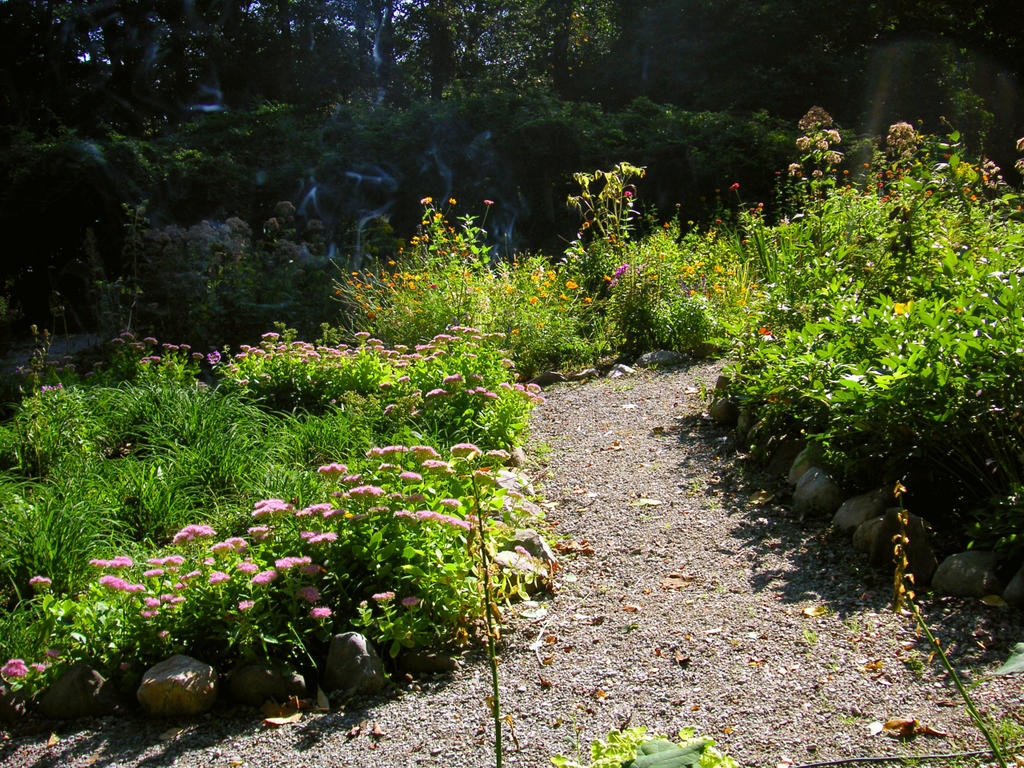
Yesterday a visitor strolled through the formal garden at the Wildflower Woods while I was rescuing peonies from the feral ravages of ginger. The visitor, who read Gene Stratton Porter's books when she was young, was pretending to be walking through The Magic Garden. I pretended to be an old Italian male gardener to enhance her fantasy. With my marked lack of ability to talk in an accent, I think I managed to destroy the moment for her.

I haven't read her books since I was young. Her first books were nature studies and they didn't sell too well. So she decided to wrap the nature studies in a treacly plot and became a best-selling author, rivaling Jack London at the time. I will read the books this time to garner clues about the garden plantings.

The pictures are in the upper west end of the bed. I spent the first week cleaning quack grass out of the bed on the left and then started on the bed on the right. In the top picture you can see in the foreground the ginger overrunning the peonies. Other wildflowers have been allowed in this bed, such as the tall Joe Pye weeds and violets. The round bed in the center is suppose to be the blue bed, but is more orange and yellow now. These are just 3 of the 35 beds in the formal garden. The garden really is lovely. I just chose to start in the beds that needed the most work.

What are you reading?

Here are a few of the books I read this summer.
Mountains Beyond Mountains: The Quest of Dr. Paul Farmer, A Man Who Would Cure the World by Tracy Kidder - I strongly recommend this book about Dr. Paul Farmer and his work with infectious diseases in Haiti and other countries. While I'll never be a Paul Farmer, he encouraged me to not give up even if the situation seems insurmountable.

Stones from the River by Ursula Hegi - This novel is over ten years old so you may have read it already. I almost set it down because I didn't want to read about a zwerg (dwarf) in Hitler's Germany, but I'm glad I kept reading as it taught me that everyone needs to figure out how to handle whatever it is that makes us different.

The Pilots Wife by Anita Shreve - Not in the same class as the other two books, but a good page-turner.

I enjoy detective novels. My all time favorite is Nero Wolfe and Archie Goodwin. I've discovered that I like an impertinent but intelligent, wise guy character (Archie). That's part of the reason I also enjoy Nelson DeMille's character John Corey in Plum Island and The Lion's Game. I was looking forward to reading James Patterson as I've heard him favorably mentioned. I read two of his novels this summer, Cat and Mouse and The Big Bad Wolf, and was disappointed in both, probably because they were too graphic and too far-fetched. I was pleasantly surprised by a compendium of mystery stories written by Dorothy Sayers.

Of course, I skated through the last Harry Potter book, but am trudging through The Art of the Commonplace: The Agrarian Essays of Wendell Berry. I agree with a lot and I disagree with a lot of what Berry has to say, but these essays make me think and I like his writing style.
These are the books that were recently recommended to me. If you have read them, would you recommend them?
Blue Virgin by Tracy Chevalier - My friend Mary recommended this book and she rarely steers me wrong. Here's the Amazon description which calls it "clunky," but I enjoyed Chevalier's Girl with a Pearl Earring.

One Thousand White Women: The Journals of May Dodd: A Novel
by Jim Fergus - Another friend that has given me great book tips (Peace Like a River, Girl Meets God) recommends this story. Would this be called alternate-history since a Cheyenne chief really did propose to trade 1000 horse for 1000 white women?

Gilead: A Novel by Marilynne Robinson - I understand that this is an excellent book, especially about fathers and sons, although the premise wouldn't indicate it.

The Color of Water: A Black Man's Tribute to His White Mother by James McBride - I don't know the person who recommended this book (it was through my husband's work at the writing center), so if you have read it, let me know what you think.
As we head into the fall and winter months (prime reading seasons just like spring and summer), do you have any book recommendations for me?

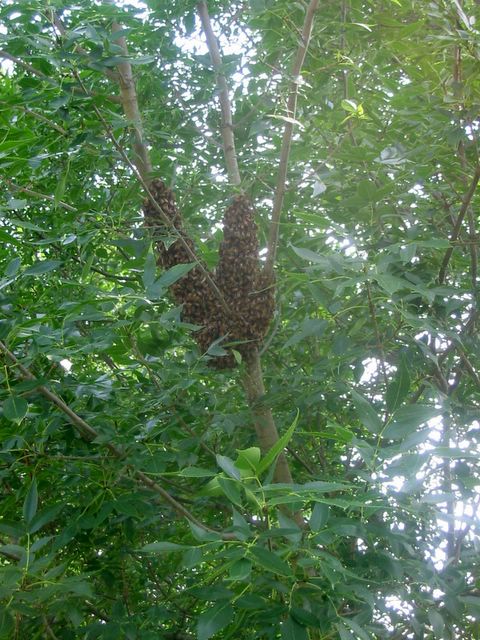
A book club friend called me this morning for my advice on this swarm of honey bees her son just found in their front yard. Since I read "The Secret Lives of Bees" and "A Country Year," I became interested in having a few hives of these interesting, beneficial and productive insects. I got a few more books from the library and talked to several beekeepers, but did not have time this spring to start the hives and was not prepared to help her. She called a beekeeper who tried coaxing them into a box. Because wild or feral honeybees were almost wiped out due to varroa mites, this was a very unusual and interesting event. Posted by Hello

Nurturing the soul through gardening

I wasn't sure what I would post today, until I read a review of a recommended book. The book is Death by Suburb: How to Keep the Suburbs from Killing Your Soul by Dave L. Goetz. A friend at church, the source of many good book recommendations, thought I would like this book about searching for community. It sounds pretty good, but a comment by the first reviewer made me cringe at his cluelessness about gardening:
In the pleasant bedroom communities of America, it can seem as if people are more concerned with tidy flowerbeds than they are the things that nurture the soul.
When I need to nurture my soul, I get down on my knees, hands in the dirt, working with God's creation. I observe the beautiful flowers, the patterns in the leaves, the growth habits, the tiny creatures, how it all works together. I breathe in the fragrant air, whether from newly-turned earth or flowers. I feel privileged to be part of it, to create a thing of beauty. My stresses melt away and I live in the moment.

Then later in his review he uses a garden as an example of ways to move toward more silence! If the garden can nurture the soul of a visitor, how much more does it nurture the soul of the gardener?

Now if he had referenced perfectly manicured, overly chemically-treated lawns as a soul-sucking surburban activity, then I would have nodded my head in agreement!

Four Books

I only have 13 labels under books and that is just not acceptable. If a book is good, I normally finish it before starting another. For some reason, I now have four good books underway: political history, gardening essays, classic novel, and contemporary novel.

Team of Rivals: The Political Genius of Abraham Lincoln by Doris Kearns Goodwin is one that I could not put down until the war started. The Civil War was so horrorific that I have to force myself now to read about the battles, the mistakes, the lost lives.

I'm reading The Essential Earthman by Henry Mitchell. I'm going a little slower than I normally would on this book because I'm posting thoughts about the essay for the gardening book club.

Since Team of Rivals is such a thick book, I couldn't read it while on the exercise bike, so I grabbed Vanity Fair by Thackeray off the bookshelf. So this is my exercise reading.

Finally, I need to start The Tortilla Curtain by T. C. Boyle for December book club. I'm looking forward to this read.

The Essential Earthman by Henry Mitchell

Carol at May Dreams Garden had a good idea for us garden bloggers this winter, a book club, and this is our first book. I read this several years ago and look forward to reading it again. This is not a "how to" book, but a series of delightfully honest and well-written essays focusing on the joys and agonies of gardening. I read three essays tonight and here are my thoughts:

On the Defiance of Gardens
"...it's about time for another summer storm to smash the garden to pieces, though it may hold off until the phlox, tomatoes, daylilies and zinnias are in full sway." For me, it is always the peonies that take the brunt of storms. I tend to pick a huge bouquet just before they fully open so I can enjoy them.

"Indeed, almost any garden, if you see it at just the right moment, can be confused with paradise." This is one reason I enjoy taking photos of my garden. I also think perspective is important in viewing the garden as paradise. Just crop out the ugly parts. This is why I don't let the pictures of perfect gardens in magazines bother me anymore. I've gardened long enough to know that no garden is perfect.

"Whenever humans garden magnificently, there are magnificent heartbreaks." Almost a hundred years ago, Gene Stratton-Porter was concerned about the loss of native plants and transplanted over 10,000 wildflowers into her woods. She kept meticulous records and every year she added Hookers Orchid to her orchid bed. Her garden was neglected for about 50 years and Hooker's Orchid (Platanthera hookeri) was last seen in Indiana in 1969. That breaks my heart.

And he ends the essay describing how gardeners must be defiant to the "natural way." While I understand the whole concept of a garden is not natural and we are often fighting against nature's way (weather, weeds, design), I disagree that a desert or a swamp cannot be seen as a "garden." Here is my proof.

Earthman vs. the Seasons--Winter
"Resolve not to try delphiniums...again." But I have to! Gene's garden was filled with delphiniums. There are none now. I've tried them several times in my home garden with nice displays the first year and nothing after that. Another winter project-figure out how to grow delphiniums in northern Indiana!

"I must never let anybody know I suffer because..." This hit home. It is so easy to complain about what's not right, what I plan to do, how I meant it to look, rather than simply be grateful for what's right, what worked, and how it looks this moment. At work, Carol and I sometimes forget to enjoy the garden. Visitors' comments help us see the garden with fresh eyes and we've made it a habit to walk through the garden and look at all 35 beds at least once a week, noting what's beautiful as well as what needs to be done.

Earthman vs. the Seasons--Spring
There was a long section on various cultivars of daffodils. I love daffodils but their names have been lost if I ever had them. So many were "pass along" bulbs. The situation is even worse at the site. Next year I may have to try his highly recommended "Passionale." I'm a sucker for fragrant flowers.

Then he turns his attention to perennials, which most nurserymen sell in the spring, although "field-grown clumps, planted in the fall, are best." He's right. And the plants you find in the stores in the spring are forced to bloom before their time. You bring home a spent plant and then have to nurse it back for several years before they "show what they can do." This is because the nursery trade sells more plants if they are in bloom. That's bad enough for annuals, but even worse for perennials. The plants Mitchell mentions in this essay are all rather common, but delightful mainstays in my gardens: phlox, baptisia, hosta, daylilies, peonies, foxgloves, primroses, columbines, coral bells, hollyhocks, and shasta daisies.

Love Hostas? - Then You Will Love "The Hostapedia"

Normally I do not write on books, but The Hostapedia by Mark R. Zilis has become the most used book in my gardening library (and it is starting to look the part). I grow hostas and I have been learning how to hybridize them. I purchased this book for many reasons. The main reason being to learn more information on each individual hosta that grows in my garden. The Hostapedia contains over 7,400 informational descriptions of hostas all listed in alphabetical order. I have not found a hosta in my garden, customer's gardens or the local nurseries that were not in this book. The book contains growing information from starting from seed to the mature plant. The information on hybridizing has been excellent for someone like myself, who is learning. The Hostapedia includes information on developing new hostas, patents, trademarks, breeder rights and how to register that new hosta plant. Did I mention photos? The Hostapedia has over 1,897 colored photos and has helped in identifying my plants along with increasing my wish list for new plants. The Hostapedia is a great reference book and with all that information, it is also a HEAVY book (1,125 pages). If you are looking for a new book to add to your gardening library, I would suggest adding The Hostapedia by Mark R. Zilis.


Happy Gardening!


The Creative Gardener

Don't forget to pick!

Soil

I have a love affair with soil. Sure, the blooms entice me into the garden and the foliage seduces me to remain there, but neither compare to the sensuousness of soil, especially early spring soil. The pungency. The sensations as I crumble it in my hands. The dark color.

Last summer, my husband and a community service worker built a three-bin compost site at the historic garden: one very large bin to hold the new stuff and two smaller bins to turn the compost as it ages. I can't wait to get my hands on the finished compost this spring to mulch the beds. Plus we will be using the compost bins to explain soil and composting to the school children when they visit on field trips.

So I am sorry I did not have a chance to read January's book selection for the Garden Bloggers Book Club, Teaming with Microbes: A Gardeners Guide to the Soil Food Web by Jeff Lowenfels and Wayne Lewis. Read the bloggers' comments here. This is definitely on my to-read list.

More: I meant to mention that the Renegade Gardener listed this book as his Top Pick this month. Also I want to attend this public conference at Merry Lea Environmental Center September 28-30.
Sacred Soil: Reclaiming the Source of Our Food
Each fall, Merry Lea holds a conference for people of faith who share a passion for the care of creation. Participants spend much of their time outside, exploring a theme that enables us to experience renewal and hope through an in-depth look at the way ecosystems function. This year's theme, Sacred Soil, will explore the truth about food. For many of us, even those of us who “know better,” food comes from the grocery store. It is a cheap commodity, manufactured by a corporation and produced in a factory like Happy Meal toys or rubber boots. In reality, food comes from the earth; it is grown in the soil and depends on the health of the soil. Soil is sacred because our lives depend on it, and because it was created by God. The registration fee of $75 includes six meals. Lodging available for $15/night upon request.

December's Garden Book

This month's book is My Favorite Plant edited by Jamaica Kincaid. Carol has given us the option of just posting our favorite flower. Perhaps I need to read the book for inspiration, because my favorite plant changes frequently. I'm indiscriminate, a promiscuous plant person. So here are some of my phases.

My garden is filled with remnants from my iris phase. I started with bearded irises, a demanding mistress. To remain vigorous, they need divided too often. The bloom period was short and the blooms were almost too showy. I lost interest in these demanding floozies, when I planted their well-behaved, refined cousin with attractive foliage, the Siberian iris. I have very tall dark purple, Butter & Sugar (yellow and white) and Steve (light blue). I then added a mix of Japanese iris and finally wild iris (blue flags and yellow flags) around the pond. These iris still give me great pleasure, but I can no longer label them "My Favorite Plant."
Siberian IrisesBlue Flag

Another phase was old roses. It started with transplanting Harison's Gold from an abandoned farmstead. You can tell from the picture of the yellow roses that it thrived in my garden. Then I ordered several old roses, charmed by their history: Empress Josephine, Apothecary and several others whose names I have lost. Moving on, I then planted about five types of David Austin roses, striving for the fragrance and form of the old roses but with repeat blooms. The last roses I planted were blushing Knock-Outs, not an old rose but still a nice addition to the garden.

Harison's Gold
Empress JosephineBlushing Knock Out
When I first moved here, my favorite plants were wildflowers, thanks to my meadow and woods. These are still some of my favorite flowers. I'm amazed at the color combinations and the health of these plants.

Black-Eyed Susans and Asclepias tuberosaCommon Milkweed - look at the intricate detail and they are so fragrant
Volunteer Cattails and Joe-Pye Weed
Jack in the Pulpit

I'm just finishing a container phase. I enjoy designing these "mini-gardens" because it was easy to experiment with plant combinations and colors. And then you combine the containers for a larger display. Next year I will still have some containers, but with 3 acres to plant and the watering demands of containers, I think I will scale back.

Created for Master Gardener talk

Over the years, I've flirted with dianthus and still have three species and several cultivars in the garden. I'm still in love with Lady's Mantle. The foliage is so attractive and the chartreuse flowers fill in bouquets so nicely. Another favorite is columbine. And I could go on and on!

Dianthus "Essex Witch"
Lady's Mantle

I'm in the middle of a sedum phase. Do you know how many sedums there are and how different they look? The blooms are unusual, usually red (from light pink to almost black) or yellow. The foliage is attractive from early spring to late fall, with a wide variation in color (light and dark green, red, dark purple) and form (trailers to upright). Planted together, they form a tapestry of color and shape. Perhaps I will get a picture of these next summer.

I'm just entering a tricyrtis or toad lily phase. I have three varieties and and longing for more as I peruse the garden catalogues.

So with this long post, I think I have sufficiently supported my thesis: I am too fickle to have a favorite plant. This reminds me of a Robert Louis Stevenson poem I learned in my youth, which I have found to be true these many years (and I added another year today...Happy Birthday Earth Girl).
The world is so full of a number of things,
I'm sure we should all be as happy as kings.


No Matter How He Speaks, My Knees Grow Weak

My husband speaks all five languages of love.

Words of Affirmation
The other night, Steve came in the room and shared that he was reading about the different aspects of intelligence. He determined that I was gifted in at least 4 areas and perhaps in the other two. He never fails to proclaim his love for me daily, usually with three simple words, "I love you," sometimes with one word, "luvsya," and, at other times, with a full poetic expression of his love. He even renamed a constellation for me; Orion's Belt is known as Martha's Crown in our house.

Acts of Service
What an incredible feeling to come home and find the floors mopped, the table set and dinner started. Sometimes he tells me to go back to sleep and he will handle the morning chores. And I can't begin to describe the work he does on our three properties. He's also teaching our sons to speak this language of love.

Receiving Gifts
I don't need diamonds to know he loves me. His gifts are sweet and thoughtful. Last week while shopping with him, I remarked how much I love hyacinths in the house as a foretaste (or is it a foresmell) of spring. We drove separate cars to church Sunday and when I came home, two decorated paper bags were on the dining room table. Inside were three pots of hyacinths. Not only did he listen, but he remembered that this was something that would please me.

Quality Time
He will grab my hand with a "join me" for an evening walk. We walk, we hold hands, we talk. Rarely are these talks utilitarian, about the running of our daily lives. Sometimes we dream. Sometimes we play silly word games. Sometimes we share our observations about the wooded area we walk. Sometimes we talk about the books we're reading. Sometimes we solve the world's problems. This is the time I often tell him stories from the blogs I've read and he tells me stories from school. Sometimes we walk in companionable silence. After 14 years of marriage, our pure delight in each other's company continues to grow.

Physical Touch
And then my knees really grow weak.

New Book for Small Hostas


If you want to grow small hostas, I have the book for you. "The Book of Little Hostas" was on my Christmas wish list this year and I got my wish. I have very much enjoyed reading this book and found many good ideas that I plan to use. "The Book of Little Hostas" was written by Kathy Guest Shadrack and Michael Shadrack with Diana Grenfell as the Consultant editor. The book contains information and photos of over 200 small and mini hostas available on the market. It also contains good information on collecting, growing and caring for these very small hostas.


Small hostas grown in a hypertufa bowl


I enjoy growing the large hostas, but I have recently started collecting small hostas. Small hostas look wonderful when planted with other small hostas in the garden as a collection or by planting them in containers. There are many creative ways to plant small hostas and this book shows many good ideas. If you live in a retirement center or apartment where you only have a deck, patio or balcony, here is a wonderful way to garden that is easy to do and easy to maintain. If you love hostas, check out "The Book of Little Hostas".


Happy Gardening!

The Creative Gardener


As I Lay Dying

I avoided reading Faulkner for many years. I'm not sure why, just that I had a sense that his writing was difficult to read. But reading books that I might not otherwise read is one reason I enjoy my book club so much.

This month's book is As I Lay Dying. I read it almost in one sitting. It was compelling. Compelling like watching a train wreck.

His style is not difficult to read. In fact, he writes beautifully. Charlotte Bronte's Jane Eyre--now that was some difficult reading.

Architect Louis Henri Sullivan said, "Form ever follows function." This doesn't mean that function is more important than form, but as Frank Lloyd Wright said (although he didn't practice it), "form and function should be one, joined in a spiritual union." Applying that to As I Lay Dying, the form (writing) is beautiful but the function (plot and characters) is repulsive.

When I finished the book, I was desolate. I don't need happy endings in a book, but I do need a sense of hope.

The woman (PhD in English) who is leading the discussion of this book has asked me twice about the humor in the book. I just didn't see any humor as I read the book nor as I think about it. She suggested that setting Cash's leg in cement was both tragic and humorous. I thought it was only tragic. It was stupid and harmful. This is a crippled family and all of Faulkner's beautiful words did not change that underlying sense of hopelessness I felt. And I can't think of anything I "learned" because of reading this book. I already know that there are crippled people in this world; I am not tempted to set legs in concrete; I know to bury a dead body before the vultures track it; you don't cross a raging flooded river; a father doesn't steal (horses and money) from his children; you don't beat children so you can feel; and a promise to a dying loved one should be tempered by the reality of those who live.

About the only "example of language that you think is particularly poignant, or beautiful, or philosophically perspicacious," as we've been asked to note, is Cash's thoughts about Darl:
"Sometimes I aint so sho who's got ere a right to say when a man is crazy and when he aint. Sometimes I think it aint none of us pure crazy and aint none of us pure sane until the balance of us talks him that-a-way. It's like it ain't so much what a fellow does, but it's the way the majority of folks is looking at him when he does it."
Oh, and Darl's drinking stars out of the gourd at night created an especially beautiful word picture.

So am I missing the boat on this book? Should I try another Faulkner book? Are all his books desolate and repulsive?

UPDATE: Here is review of the book. I'm not sure I agree with the reasoning, although it gives me some things to ponder, such as the implied relativism of the form of the narrative. However, perhaps the conclusion, that it is not only bad but evil, would explain my sense of desolation after I finished the story.