 We were cleaning brambles out of a clearing in the woods and planting some trees when the sun set this evening. This photo has not been modified. It was just awesome. Then as I was browsing some blogs I frequent, I saw a similar photo, which was just awful. I can't imagine the horror of a firestorm.
.

Showing posts with label Nature. Show all posts
Showing posts with label Nature. Show all posts
Fall Sunset
We were cleaning brambles out of a clearing in the woods and planting some trees when the sun set this evening. This photo has not been modified. It was just awesome. Then as I was browsing some blogs I frequent, I saw a similar photo, which was just awful. I can't imagine the horror of a firestorm.
Wild Pectin
My "go-to" cookbook for years has been The Joy of Cooking, because it includes so much background information. For example, the intro to jellies includes information about pectin. By using natural pectin, instead of commercial pectin such as Sure-Gel, jellies require about half the sugar resulting in an intense fruit flavor.
But the seven bags of Concord grapes on my counter are not high in pectin. The Joy gave several options for natural pectin for grape jelly: use under-ripe fruit, use wild grapes, add an apple. So here are the steps for making low-sugar grape jelly without commercial pectic:
1. Take a ride on the river.
Make a date with your husband to go to the St. Joseph River in the Western Lake Erie watershed. Nose the riverboat into shore and cut off (prune?) the vines until you have a large pile on the floor of the boat. Remove the clusters. Step on numerous tiny grapes (they are smaller than blueberries), staining the floor with unique patterns of reddish purple. Watch the moon rise as you head back to the landing. Some sweet smooching is required at this point.
2. Ignore all warnings posted on the blog of an Internet friend.
Google "wild grape jelly" and find this post by Kylee, which includes the money quote:
Yes, it takes a long time. Kylee is right. To break the monotony of this chore, make two batches of Concord jelly using some under-ripe fruit and half an apple to 8 cups of grapes. Making jelly with natural pectin requires a candy thermometer to know when the syrup reaches the sheet stage. If you are easily entertained, as I am, use the spoon method to test the jelly as well as the thermometer. Instead of the one or two minutes required with commercial pectic, this approach takes about 30 minutes of cooking.
4. Accept five bags of peaches and pears from brother.
At this point, you may be getting slightly insane, so when your brother calls and offers you peaches and pears from his orchard, resist the offer. Remember you still have four bags of grapes left on your counter. I didn't resist. My son drove over and collected the fruit so it could sit on my table. I ran out of counter room.
5. Cook, drain and strain the fruit.
The proportion of seeds to juice for wild grapes is about 10 times more than for Concord grapes. Empty the cooked wild grapes into a fine mesh strainer, listening for the clunk of seeds instead of the usual plop. For clear jelly, strain for 15 hours. Skip the straining if you are getting impatient or if you must use every last edible bit of these grapes.
6. Add sugar to grape juice and boil until it gels.
Add the sugar gradually, tasting the syrup until it is the right combination of sweet and tart. The wild grapes will gel in about ten minutes.
7. Seal in small jars.
It is important to use the smallest jars possible. This is precious stuff. Don't calculate the cost of each jar based on your consulting rate. You may weep.
8. Let your son lick the pan.
And smile knowingly when he raves about the taste.
But the seven bags of Concord grapes on my counter are not high in pectin. The Joy gave several options for natural pectin for grape jelly: use under-ripe fruit, use wild grapes, add an apple. So here are the steps for making low-sugar grape jelly without commercial pectic:
1. Take a ride on the river.
Make a date with your husband to go to the St. Joseph River in the Western Lake Erie watershed. Nose the riverboat into shore and cut off (prune?) the vines until you have a large pile on the floor of the boat. Remove the clusters. Step on numerous tiny grapes (they are smaller than blueberries), staining the floor with unique patterns of reddish purple. Watch the moon rise as you head back to the landing. Some sweet smooching is required at this point.
2. Ignore all warnings posted on the blog of an Internet friend.
Google "wild grape jelly" and find this post by Kylee, which includes the money quote:
The first thing I had to do was take all those tiny grapes off their stems. This job reminded me of shelling peas. It takes forever and a day of cleaning those before you get enough to feed two people one time.3. Spend five hours de-stemming the grapes.
Yes, it takes a long time. Kylee is right. To break the monotony of this chore, make two batches of Concord jelly using some under-ripe fruit and half an apple to 8 cups of grapes. Making jelly with natural pectin requires a candy thermometer to know when the syrup reaches the sheet stage. If you are easily entertained, as I am, use the spoon method to test the jelly as well as the thermometer. Instead of the one or two minutes required with commercial pectic, this approach takes about 30 minutes of cooking.
4. Accept five bags of peaches and pears from brother.
At this point, you may be getting slightly insane, so when your brother calls and offers you peaches and pears from his orchard, resist the offer. Remember you still have four bags of grapes left on your counter. I didn't resist. My son drove over and collected the fruit so it could sit on my table. I ran out of counter room.
5. Cook, drain and strain the fruit.
The proportion of seeds to juice for wild grapes is about 10 times more than for Concord grapes. Empty the cooked wild grapes into a fine mesh strainer, listening for the clunk of seeds instead of the usual plop. For clear jelly, strain for 15 hours. Skip the straining if you are getting impatient or if you must use every last edible bit of these grapes.
6. Add sugar to grape juice and boil until it gels.
Add the sugar gradually, tasting the syrup until it is the right combination of sweet and tart. The wild grapes will gel in about ten minutes.
7. Seal in small jars.
It is important to use the smallest jars possible. This is precious stuff. Don't calculate the cost of each jar based on your consulting rate. You may weep.
8. Let your son lick the pan.
And smile knowingly when he raves about the taste.
The Voyager's Maiden Voyage
Last weekend, Steve and I finally slipped away to Michigan, just over the state line, to camp and canoe the Fawn River near Sturgis. It has been likened to rivers in Canada by more than one nature writer. The night before we left, Steve finished the canoe.

We had a great time with my brother, his girlfriend and four other couples camped in the crook of the Fawn near Sturgis. Two of my brothers have camped here by permission of the landowner for almost 30 years, but this was my first trip. We had such a good time that another couples trip was scheduled for October.
Brother John, whom I call Fireboy, is the fire architect. Sunday night he put a large hollow log upright on the fire and we watched flames shoot through the chimney and discussed which way it would fall. In this picture, he is bracing the chimney with several "small" logs in the foreground.


We had a great time with my brother, his girlfriend and four other couples camped in the crook of the Fawn near Sturgis. Two of my brothers have camped here by permission of the landowner for almost 30 years, but this was my first trip. We had such a good time that another couples trip was scheduled for October.
Brother John, whom I call Fireboy, is the fire architect. Sunday night he put a large hollow log upright on the fire and we watched flames shoot through the chimney and discussed which way it would fall. In this picture, he is bracing the chimney with several "small" logs in the foreground.

Living things in my garden
This PM decided to take up residence on a Coronation Gold yarrow for the summer. He has doubled in size since I first spotted him and has changed from all green to green and brown. Normally I deadhead the yarrow, but not this year. 
I didn't post often this spring but here's a picture of a snapping turtle looking for a place to lay eggs. Steve took this picture into his 4th grade classroom since they were studying reptiles at the time.


I didn't post often this spring but here's a picture of a snapping turtle looking for a place to lay eggs. Steve took this picture into his 4th grade classroom since they were studying reptiles at the time.

Glad Grasshopper
I found this fella snuggled between two glad blooms. I think it would be a delightful place to hang out.


Rain, Glorious Rain
We have had a drought this summer. While we are only 3.5" under average for the year, most of the rain came in April and early May. We may have had a tenth of an inch this summer...until last Saturday. It rained again yesterday and I gloried in it. It is raining now. Except it is coming down at a rate of 2" to 4" an hour! Couldn't we have long gentle rains periodically? I'm sure the hydrangea blooms are on the ground and I wonder if my staked plants (delphiniums, dahlias, etc.) are holding up at the site.
Projects
Since I created a new tag called Projects for the bridge and canoe projects, I had to share some of my projects. No, not the apron. It's still uncut, but not forgotten. My great niece has an apron in a similar style which I plan to use to resize the Grandma's pattern.
One project was arranging the planting of over 100 trees at The Third Place this spring. It was an intergenerational event. They posted pictures on the church website and I especially like the one of the girls right in the hole they dug. These same girls, not 30 minutes earlier, said they didn't want to get dirty. We've had lots of rain this summer, which is a good thing since there is no way we can water the trees on the far end of 30 acres.
With Steve teaching and not "studenting," we've added another dimension to our wardrobe, necessitating giving up part of our bedroom for a larger closet. Steve's portion of this project is almost complete and now I need to start painting. We are painting the bedroom four different colors. I hope it works. I have also been hunting for new curtains, without any luck.
Of course, there are always numerous garden projects in various stages. Ron dug out some overgrown shrubs by the back deck and now I need to decide what to plant there. I've planted an even bigger veggie garden and this is the first year I've grown corn. I created a new bed in my front yard and planted it. But these are all normal garden activities for me. My project involves my growing interest in native plants.
We have always let our pond edges grow naturally, resulting in volunteers of cattails, sedges, Queen Anne's Lace, milkweed, black-eyed susans, and even Joe Pye Weed. We did plant blue flags many years ago and they have claimed a large portion of the north end of the pond. Last year I planted three starts of yellow flags. However, the shallow end of the pond is sawgrass and cattails. It is also the first thing you see after crossing the stone bridge. Last fall I collected seeds from swamp hibiscus, pink turtlehead and cardinal flowers, all plants that love their feed wet. At the encouragement of Kylee, I winter sowed the seeds and they grew! So I've been hacking away at the growth to plant them on the shallow end of the pond. Let me tell you, removing turf and amending clay soil is easy compared to sinking in muck and getting scratched by the grasses to battle swamp weeds. In addition to the plants I started from seed, I planted Queen of the Prairie. If this works out, it will be breathtakingly beautiful.
One project was arranging the planting of over 100 trees at The Third Place this spring. It was an intergenerational event. They posted pictures on the church website and I especially like the one of the girls right in the hole they dug. These same girls, not 30 minutes earlier, said they didn't want to get dirty. We've had lots of rain this summer, which is a good thing since there is no way we can water the trees on the far end of 30 acres.
With Steve teaching and not "studenting," we've added another dimension to our wardrobe, necessitating giving up part of our bedroom for a larger closet. Steve's portion of this project is almost complete and now I need to start painting. We are painting the bedroom four different colors. I hope it works. I have also been hunting for new curtains, without any luck.
Of course, there are always numerous garden projects in various stages. Ron dug out some overgrown shrubs by the back deck and now I need to decide what to plant there. I've planted an even bigger veggie garden and this is the first year I've grown corn. I created a new bed in my front yard and planted it. But these are all normal garden activities for me. My project involves my growing interest in native plants.
We have always let our pond edges grow naturally, resulting in volunteers of cattails, sedges, Queen Anne's Lace, milkweed, black-eyed susans, and even Joe Pye Weed. We did plant blue flags many years ago and they have claimed a large portion of the north end of the pond. Last year I planted three starts of yellow flags. However, the shallow end of the pond is sawgrass and cattails. It is also the first thing you see after crossing the stone bridge. Last fall I collected seeds from swamp hibiscus, pink turtlehead and cardinal flowers, all plants that love their feed wet. At the encouragement of Kylee, I winter sowed the seeds and they grew! So I've been hacking away at the growth to plant them on the shallow end of the pond. Let me tell you, removing turf and amending clay soil is easy compared to sinking in muck and getting scratched by the grasses to battle swamp weeds. In addition to the plants I started from seed, I planted Queen of the Prairie. If this works out, it will be breathtakingly beautiful.
Our Fourth
Two days. Two couples. Too much fun.
Saturday morning we needed jackets as we took our camping gear to The Highlands with the top down and doors off the Jeep. On the way, a grey fox stepped out of the cornfield, stared at us and then loped back into the woods. After meeting our friends for breakfast and decorating ourselves with "Growing Wild for Conservation" tattoos, we loaded up two kayaks, one Rob Roy (Steve built it) and two solo canoes and headed north to paddle Pigeon River.


We put in at the bridge by Highway 327. The water was cold and the current was strong. Tammy, Stephanie and I used our paddles only to guide us, but we suspect Steve and Brian used their paddles to paddle backwards as we outdistanced them.
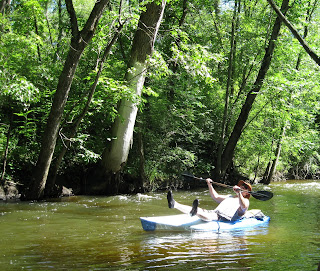
We pulled over at the first bridge to wait for them as there is a little rapids over an old dam. After "wheeeing" over the dam, we exited our boats and body surfed in the water. You can see Stephanie at the far left of the first picture, which I took when she first jumped in the fast water.


These photos show the brushy area where we tied off. Brian grabbed a dark branch to steady himself and it moved quickly into the water. The snake headed straight for Stephanie and tried to get in the Rob Roy. Just a little shriek was heard above the roar of the water.


The next section took us deeper into the woods. The shade was welcome and the dappled river bottom mesmerized me. In the sunny patches, swamp milkweed and pink roses were in bloom. We had a picnic lunch creekside and then tackled the last stretch. Again, the girls outdistanced the guys. So we stood on the bridge, drying off, and played with our shadows, until the guys rounded the bend.


Back at The Highlands, my brother had already started a fire, so we set up camp, cooked dinner, and played with Sampson.


As night fell, we sat around the campfire star gazing followed by a midnight walk through the woods down to the river. The night was clear and the stars were bright. We saw Draco the dragon stretching over the barn, the binary star in the Big Dipper, satellites, and shooting stars.
It was a lazy Sunday due to the heat. Our children came to visit and left. Then Steve, Brian, John, Anna and I took the river boat to watch the Leo-Cedarville fireworks from the water. I caught the setting sun but have no fireworks pictures. I put my camera away to participate rather than just observe. It was a long dark trip back to the property as we kept close watch for logjams, floating logs, and the river channel.


Saturday morning we needed jackets as we took our camping gear to The Highlands with the top down and doors off the Jeep. On the way, a grey fox stepped out of the cornfield, stared at us and then loped back into the woods. After meeting our friends for breakfast and decorating ourselves with "Growing Wild for Conservation" tattoos, we loaded up two kayaks, one Rob Roy (Steve built it) and two solo canoes and headed north to paddle Pigeon River.


We put in at the bridge by Highway 327. The water was cold and the current was strong. Tammy, Stephanie and I used our paddles only to guide us, but we suspect Steve and Brian used their paddles to paddle backwards as we outdistanced them.

We pulled over at the first bridge to wait for them as there is a little rapids over an old dam. After "wheeeing" over the dam, we exited our boats and body surfed in the water. You can see Stephanie at the far left of the first picture, which I took when she first jumped in the fast water.


These photos show the brushy area where we tied off. Brian grabbed a dark branch to steady himself and it moved quickly into the water. The snake headed straight for Stephanie and tried to get in the Rob Roy. Just a little shriek was heard above the roar of the water.
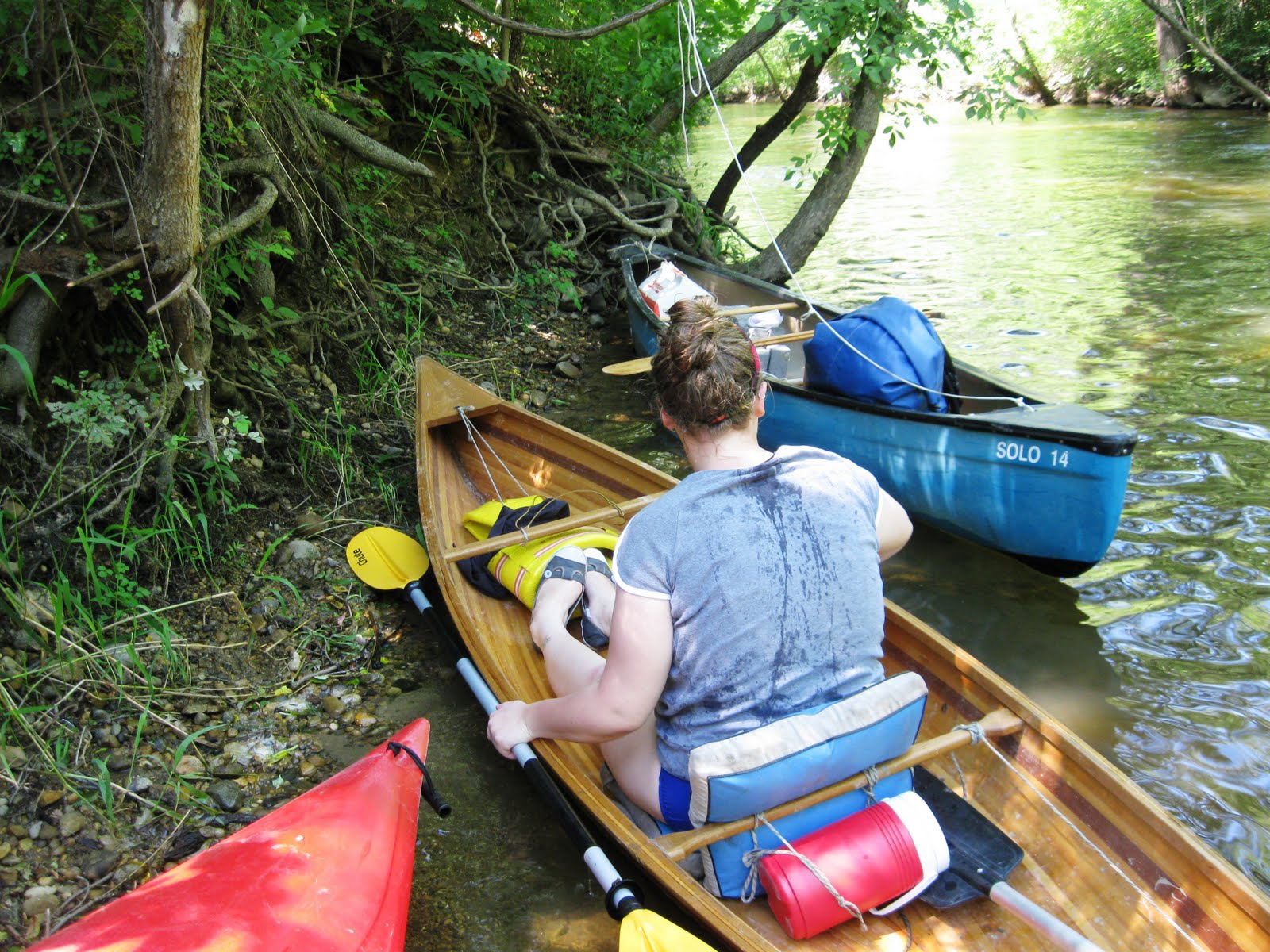

The next section took us deeper into the woods. The shade was welcome and the dappled river bottom mesmerized me. In the sunny patches, swamp milkweed and pink roses were in bloom. We had a picnic lunch creekside and then tackled the last stretch. Again, the girls outdistanced the guys. So we stood on the bridge, drying off, and played with our shadows, until the guys rounded the bend.


Back at The Highlands, my brother had already started a fire, so we set up camp, cooked dinner, and played with Sampson.


As night fell, we sat around the campfire star gazing followed by a midnight walk through the woods down to the river. The night was clear and the stars were bright. We saw Draco the dragon stretching over the barn, the binary star in the Big Dipper, satellites, and shooting stars.
It was a lazy Sunday due to the heat. Our children came to visit and left. Then Steve, Brian, John, Anna and I took the river boat to watch the Leo-Cedarville fireworks from the water. I caught the setting sun but have no fireworks pictures. I put my camera away to participate rather than just observe. It was a long dark trip back to the property as we kept close watch for logjams, floating logs, and the river channel.


Signs of summer
Last night as we left town, the outdoor temperature was 92 degrees according to the thermometer in the car. We watched it fall to 89 degrees as drove by the small airport and then rise again to 91 degrees at the strip mall. It gradually fell to 82 degrees as entered the countryside and then in the drive back to our home, it fell to a final reading of 78 degrees. It was a fifteen minute drive so time wasn't the factor in this 14 degree drop in temperature. Just another reason I love living in the country.
A short rainstorm came through tonight and broke the heat wave. Steve and I kept wandering back outside tonight, intoxicated by the glow of the first fireflies of the season, the chirping crickets and the smell of wet earth.
A short rainstorm came through tonight and broke the heat wave. Steve and I kept wandering back outside tonight, intoxicated by the glow of the first fireflies of the season, the chirping crickets and the smell of wet earth.
What was lost is now found
I have been searching for something since the spring of 1988. Yesterday I found it. Rejoice with me!

A lady's slipper! A native Indiana orchid! A Cypripedium pubescens! It is an uncommon wildflower, considered threatened in many Midwestern states.
My woods had been ravaged by the former owner who fenced it and kept goats. The goats were very destructive and we have worked hard to restore the woodlands. Every spring I searched the area where I found the lady's slipper and never found a trace. Yesterday, I was working in the woods, pulling garlic mustard, removing bush honeysuckle and marking tree starts. I was scanning every square inch of the woods, when I beheld the long-lost flower.

Oh, pretty one, where have you been?
Now for a bonus photo from the adjacent woods:

Now that's one giant jack-in-the pulpit.
“Or suppose a woman has ten silver coins and loses one. Doesn’t she light a lamp, sweep the house and search carefully until she finds it? And when she finds it, she calls her friends and neighbors together and says, ‘Rejoice with me; I have found my lost coin.’ In the same way, I tell you, there is rejoicing in the presence of the angels of God over one sinner who repents.”Over 20 years ago, the first spring I lived here, I was walking in the woods, checking it out, when a sigh of disgust at litter escaped my lips as I saw a partially inflated balloon stuck on some foliage. I went over to pick it up and discovered:Luke 15:6-10

A lady's slipper! A native Indiana orchid! A Cypripedium pubescens! It is an uncommon wildflower, considered threatened in many Midwestern states.
My woods had been ravaged by the former owner who fenced it and kept goats. The goats were very destructive and we have worked hard to restore the woodlands. Every spring I searched the area where I found the lady's slipper and never found a trace. Yesterday, I was working in the woods, pulling garlic mustard, removing bush honeysuckle and marking tree starts. I was scanning every square inch of the woods, when I beheld the long-lost flower.

Oh, pretty one, where have you been?
Now for a bonus photo from the adjacent woods:

Now that's one giant jack-in-the pulpit.
Mow gingerly
I wrote this as a comment on a native plant blog, but decided I should share this story here.
About ten years ago, we planted redbuds and tulip poplars between our lane and the woods. As the trees matured, we noticed the wildflowers expanding their territory. Bloodroot, bluebells, and monarda were the first to appear. Then we discovered jacks, bleeding heart, native sunflowers, and asters. Of course, we stopped mowing this area until there was only a mower's width up the lane to allow access to the meadow.
I love wild ginger but failed in my two efforts to establish it here. Just last week I found several patches under those redbud trees. I really wonder how they traveled so far. I was so excited and dragged my husband out to see it several times. I envisioned a carpet of ginger under those trees.
Then Ricky mowed the lawn. You know what happened next, as he was just trying to keep the lane neat. My son felt so bad because my first response was tears. My second response was hope that the ginger responds to this pruning. The other flowers will do just fine.
Aliens Attack Earth Girl's Home
Several alien invaders have insidiously established strongholds around our home, but Steve and I have been attacking them on several fronts. Here's a report from the fighting front.
Bush Honeysuckle
Twenty years ago when I noticed how much the birds like the red berries on the pretty bush by the bridge, I should have been suspicious. Now we are surrounded by bushes, blocking our view of the woods. This spring we launched a full scale attack. While there have been skirmishes elsewhere, the main battles have been along the stream bed and the meadow edges.
Autumn Olive
Oh, your heavenly scent seduced me into leaving just one or two bushes. Then you show your true colors. If you cut the thorny bush down, it sends out suckers. Off with its head with a few drops of pure glyphosate on its neck. It likes to hang out with the honeysuckle, but our brush pile is now about 20 feet tall as we attack both invasive shrubs.
Multiflora Roses
Sure, you call yourself a rose, but I call you dead. Once upon a time, I had a pretty native pink rose growing here; what did you do with her?
Garlic Mustard
Just search my blog with this term to find out how long I've been battling this alien. Every time I think I have won, I find you hiding among the canes of the multiflora roses, or under a large mayapple. And you are mutating into ever shorter plants all the better to hide from me. But I have trained my eyes to find you, even to the point of missing the morels.
Potential Threats
I won't even mention the English ivy that is trying to creep into the woods, or the ajuga romping along the stream edge, or the dandelions, or the red osier or poison ivy. And how did lily of the valley get in the woods?
Please send care packages!
Bush Honeysuckle
Twenty years ago when I noticed how much the birds like the red berries on the pretty bush by the bridge, I should have been suspicious. Now we are surrounded by bushes, blocking our view of the woods. This spring we launched a full scale attack. While there have been skirmishes elsewhere, the main battles have been along the stream bed and the meadow edges.
Autumn Olive
Oh, your heavenly scent seduced me into leaving just one or two bushes. Then you show your true colors. If you cut the thorny bush down, it sends out suckers. Off with its head with a few drops of pure glyphosate on its neck. It likes to hang out with the honeysuckle, but our brush pile is now about 20 feet tall as we attack both invasive shrubs.
Multiflora Roses
Sure, you call yourself a rose, but I call you dead. Once upon a time, I had a pretty native pink rose growing here; what did you do with her?
Garlic Mustard
Just search my blog with this term to find out how long I've been battling this alien. Every time I think I have won, I find you hiding among the canes of the multiflora roses, or under a large mayapple. And you are mutating into ever shorter plants all the better to hide from me. But I have trained my eyes to find you, even to the point of missing the morels.
Potential Threats
I won't even mention the English ivy that is trying to creep into the woods, or the ajuga romping along the stream edge, or the dandelions, or the red osier or poison ivy. And how did lily of the valley get in the woods?
Please send care packages!
What is it?

As I was tending my raised vegetable bed (the spinach is about ready to harvest), I found this strange looking thing. At first I thought it was some type of unusual seed pod, but it moved when I touched it. The pointed end on the left was segmented and the creature would move back and forth. The end with the "tail" was a hard case, shell or cocoon. I don't even know where to start identifying it. Any ideas?
UPDATE: Thanks for your help. My brother-in-law narrowed it down to cecropia moth.
Mystery plant identified
In this post, I had a mystery plant in the woods. My sister guessed an immature pokeweed and Kylee guessed twinleaf. I found the same plant in the wildflower bed at work and the site's naturalist made the identification. It is Blue Cohosh (Caulophyllum thalictroides).
Releasing the wildflowers
I started tackling the garlic mustard in our woods several years ago. It is an endless task, but this year I may have seen some rewards. The appearance of these plants could be a result of the rain we received last winter, but please let me believe that it was the result of four years trying to eradicate garlic mustard, which prevents spring ephemerals from blooming.
As I was on my search and destroy mission against the garlic mustard enemy, I found a jack-in-the-pulpit. I had found one several years ago in the northwest corner of the woods, but this was the first time I saw one in the southeast corner. This is a trillium,trillium sessile, commonly called toadshade today but known as wake robin a hundred years ago. This is the first time I've seen it in the woods. It is clump forming and I am pleased to see two plants in my emerging clump.
 Of course, this trillium, trillium grandiflora, is becoming abundant. It is so exciting to spot one in a new place in our little woods.
 This is known as lady's thumb. I heard a story about the "bloody" thumbprint and tried to find it online to no avail. She pricked her finger was one version and another version as she murdered her husband and left evidence on this little plant. Online I found a Scottish tale about the plant was at the foot of the cross. Or you can make up your own story!
 The mayapple patches are spreading. Steve and I wondered about the two distinct shapes in this patch.
  And this is my unknown but distinctive plant. The stems are a glaucous blue. No flowers yet. I'll have to keep monitoring it.

As I was on my search and destroy mission against the garlic mustard enemy, I found a jack-in-the-pulpit. I had found one several years ago in the northwest corner of the woods, but this was the first time I saw one in the southeast corner.
 This is a trillium,trillium sessile, commonly called toadshade today but known as wake robin a hundred years ago. This is the first time I've seen it in the woods. It is clump forming and I am pleased to see two plants in my emerging clump.
 Of course, this trillium, trillium grandiflora, is becoming abundant. It is so exciting to spot one in a new place in our little woods.
 This is known as lady's thumb. I heard a story about the "bloody" thumbprint and tried to find it online to no avail. She pricked her finger was one version and another version as she murdered her husband and left evidence on this little plant. Online I found a Scottish tale about the plant was at the foot of the cross. Or you can make up your own story!
 The mayapple patches are spreading. Steve and I wondered about the two distinct shapes in this patch.
  And this is my unknown but distinctive plant. The stems are a glaucous blue. No flowers yet. I'll have to keep monitoring it.
The Doctrine of Signatures
For years I used the scientific names of plants, eschewing the common names. This year, however, as I enjoy the spring ephemerals bursting in the woods, I am also enjoying the stories behind their common names, specifically the Doctrine of Signatures. This 16th century medical doctrine is based on the belief that God marked plants with his signature so we would know the purpose of the plant.
Today, I found the first blooms of trout lily, but the older common name is adder's tongue lily. According to the Doctrine of Signatures (DoS), this plant will heal snake bites because it looks like a snake's tongue.
Another spring wildflower is cut-leaf toothwort, whose roots were thought to resemble teeth, so this plant was used to treat tooth trouble. Even the genus name,Dentaria, reflects the DoS.
One of the most beautiful spring flowers is hepatica or liverwort. "God's mark on Hepatica was that its leaves turned liver-colored in winter and by a stretch of the imagination looked like little slabs of chicken livers."
On a sunny early spring day, the white blooms of bloodroot (Sanguinaria canadensis) are charming. The roots produce a red dye, so this plant was thought to cure blood disorders.
The may-apples in my woods are just starting to unfurl their umbrellas leaves. Although not related to the Eurasian mandrake, its roots are similar and was called mandrake in the New World. Mandrake is suppose to promote sexual passion in females due to the shape of its roots.
Today, I found the first blooms of trout lily, but the older common name is adder's tongue lily. According to the Doctrine of Signatures (DoS), this plant will heal snake bites because it looks like a snake's tongue.
Another spring wildflower is cut-leaf toothwort, whose roots were thought to resemble teeth, so this plant was used to treat tooth trouble. Even the genus name,Dentaria, reflects the DoS.
One of the most beautiful spring flowers is hepatica or liverwort. "God's mark on Hepatica was that its leaves turned liver-colored in winter and by a stretch of the imagination looked like little slabs of chicken livers."
On a sunny early spring day, the white blooms of bloodroot (Sanguinaria canadensis) are charming. The roots produce a red dye, so this plant was thought to cure blood disorders.
The may-apples in my woods are just starting to unfurl their umbrellas leaves. Although not related to the Eurasian mandrake, its roots are similar and was called mandrake in the New World. Mandrake is suppose to promote sexual passion in females due to the shape of its roots.
The lungworts (Pulmonaria) are blooming in my cultivated garden, Their spotted oval leaves looked like spotty diseased lungs to someone, thus the common and scientific name. It was used to treat pulmonary infections.
The maidenhair fern will be emerging soon in the woods of Indiana. Of course, because of its fine fronds, it was used to cure baldness when the Doctrine of Signatures was the source of medical treatment.
There are many other examples of the Doctrine of Signatures, but these are blooming now in case you want to try some superstitious medicine.
Holiday Day
My sister had Thanksgiving for my family today, or the 33 of us that could make it. Lots of good food, good conversation and laughter. As is the tradition, started by my father, we took a long walk after dinner. Niece Jennifer claimed the 7 point antler we found in the woods. My husband noted that the many children living nearby hadn't found it because they weren't out exploring the woods, or even outdoors at all, in the sunny 60 degree weather.
Ron made a trip to our tree farm this morning to cut the Christmas tree and when we got home from the get-together, we put it up. Ladders, ropes and wenches were required. It is the largest Charlie Brown tree you ever saw. And it is beautiful! It looks like a real tree. I'm a little perplexed how I'm going to decorate it as I do not have gigantic scale ornaments. Here are the stats: original tree -13+ feet; ceiling height - 11 feet; breadth of tree - 8 feet. And that's on our enclosed porch. No way will it fit into the bay window, the traditional spot for the tree.
UPDATE: I was the required wench, although we used a winch to hoist the tree. My husband is the source for this correction.

Ron made a trip to our tree farm this morning to cut the Christmas tree and when we got home from the get-together, we put it up. Ladders, ropes and wenches were required. It is the largest Charlie Brown tree you ever saw. And it is beautiful! It looks like a real tree. I'm a little perplexed how I'm going to decorate it as I do not have gigantic scale ornaments. Here are the stats: original tree -13+ feet; ceiling height - 11 feet; breadth of tree - 8 feet. And that's on our enclosed porch. No way will it fit into the bay window, the traditional spot for the tree.
UPDATE: I was the required wench, although we used a winch to hoist the tree. My husband is the source for this correction.
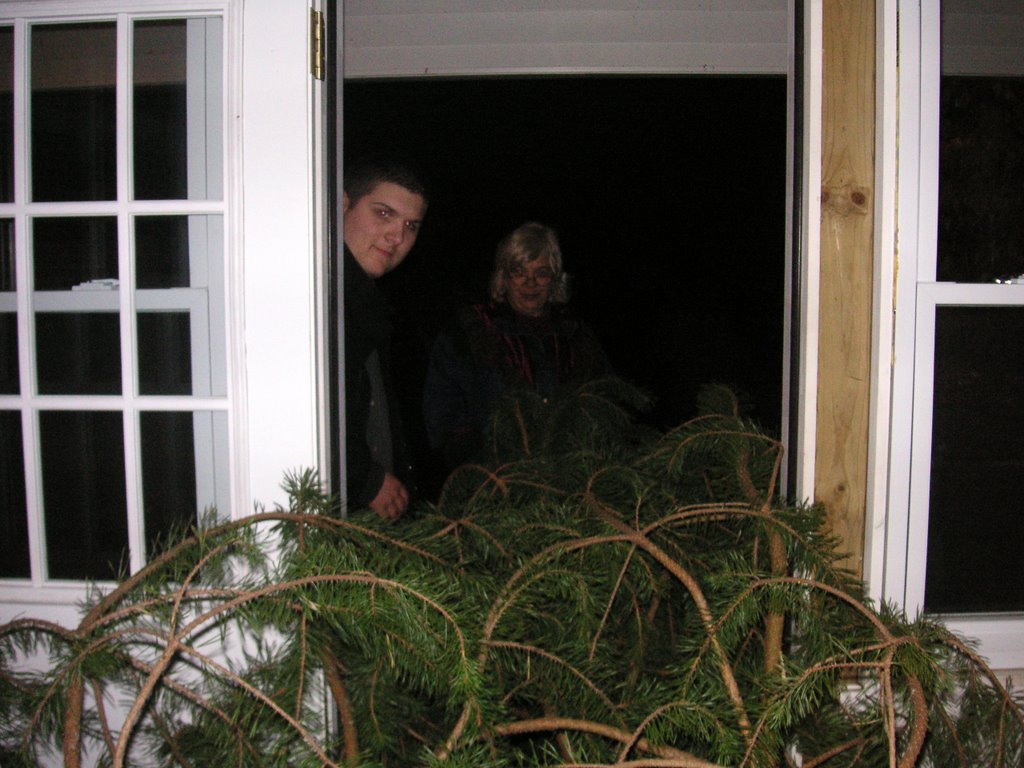
Ron, tree gatherer extraordinaire and Earth Girl herself
wondering if the tree will fit through the door.
wondering if the tree will fit through the door.
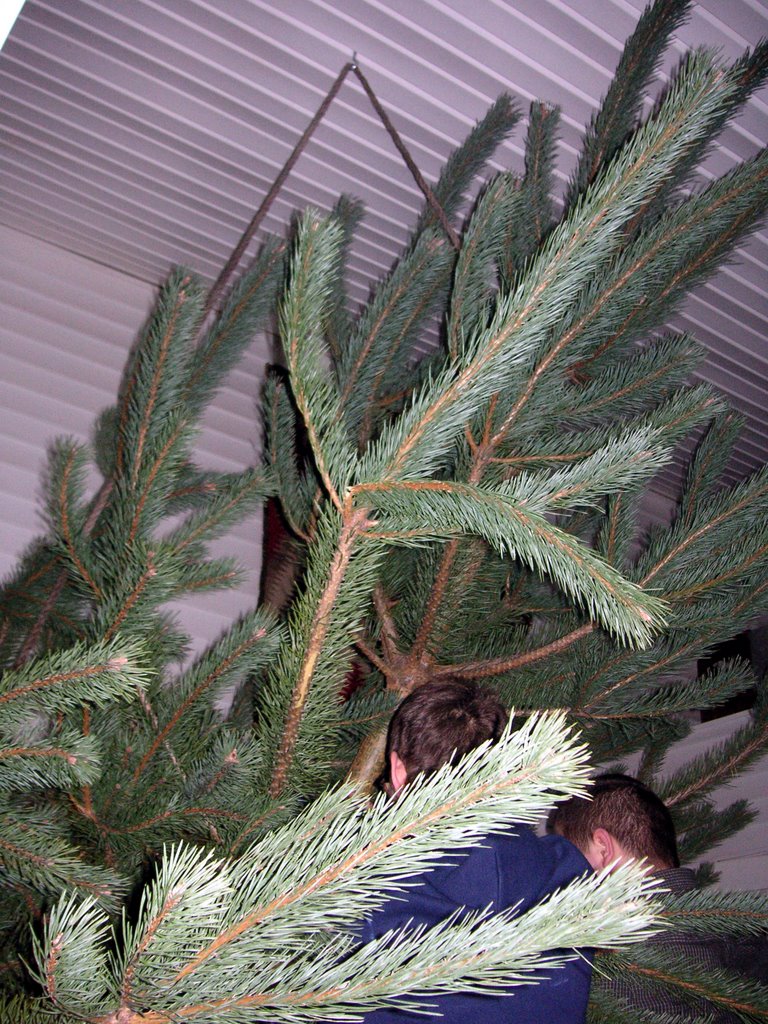
It is taking two strong teenage boys with their father on the rope to put the tree upright.

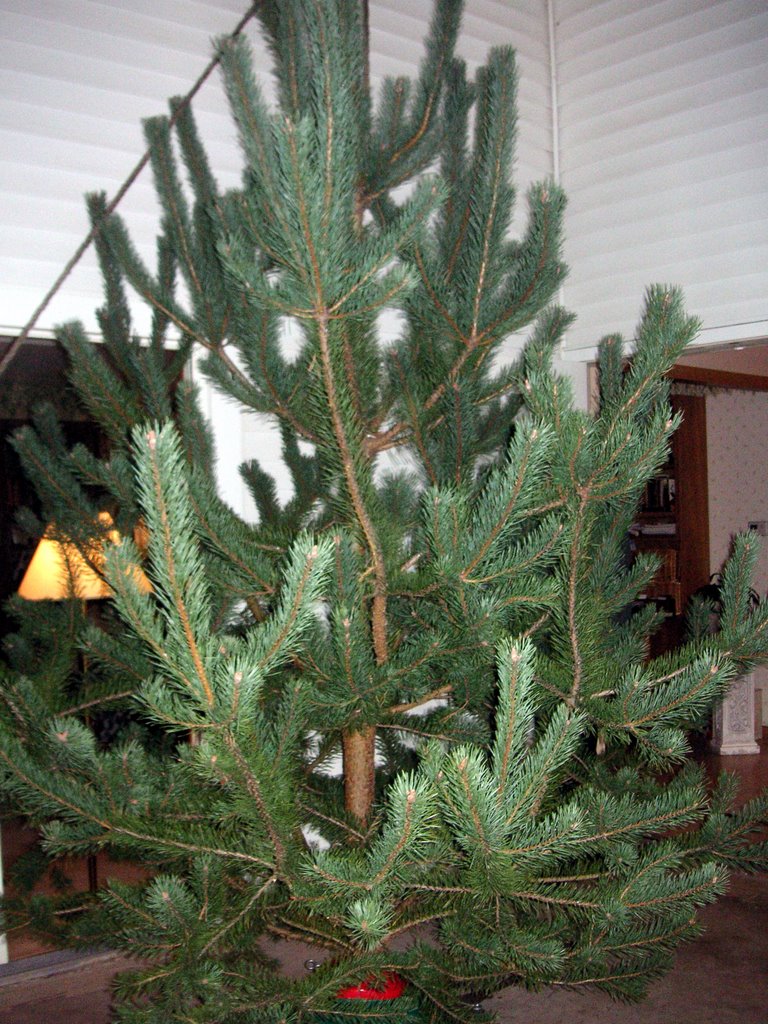
And here is the tree in all its beauty, almost there. Just need to tighten the rope a bit.
State Trees
Last evening, we planted 9 tulip poplars, Indiana's state tree, by our creek bank and one Buckeye, Ohio's state tree. I didn't mind the rain today, thinking of these trees settling into their new home. I just hope the wire cages keep the bunnies and deer away. All the trees were second year seedlings that I potted last year after weeding them from the garden at the site.
April Snow

After posting about the beauty of the moment, how can I complain about the large, wet snowflakes falling tonight? No moon, no stars, but yet the night is bright.
This is the first photo I took tonight on the road leading to our home. I set the camera for night but forgot to turn off the flash. The flash caught the large flakes slowly falling, but the snow-covered woods behind remained illuminated as I saw it.
I may have been predisposed to see beauty because we were coming home from buying new pendant lights for my kitchen.
An Easter Sunday
As my nephew, his friend and my son headed up to the road to play ball today (and why in the road when we have a perfectly good meadow?), I called after them to watch for cars. Our road is not heavily traveled, but there are two sharp curves that block vision. My husband laughed and reminded me that my nephew and his friend just returned from combat duty and could probably handle the rare car on a back road. The "boys" were good-natured about my warning though.
A walk is always on the agenda after we eat and we headed down into the lowlands next to Cedar Creek. Yes, we did get a bit muddy, but the spring flowers were just emerging. I discovered several large patches of wild leeks or ramps (Allium tricoccum). My ten-year-old nephew was especially interested in identifying animal tracks in the mud. He called me over to look at one track that he couldn't identify, but my husband identified it first. As Sean held a mud caked stick behind his back, my husband announced it was the track of the wild Sean-boy dog.
A walk is always on the agenda after we eat and we headed down into the lowlands next to Cedar Creek. Yes, we did get a bit muddy, but the spring flowers were just emerging. I discovered several large patches of wild leeks or ramps (Allium tricoccum). My ten-year-old nephew was especially interested in identifying animal tracks in the mud. He called me over to look at one track that he couldn't identify, but my husband identified it first. As Sean held a mud caked stick behind his back, my husband announced it was the track of the wild Sean-boy dog.