.

Showing posts with label Japanese maple. Show all posts

5 Plants I Want in Every Garden

Our current garden is still a work in progress, as every garden will ever be, but sometimes I like to think about what my next garden will be like.  We have no immediate plans to move but one day our growing family will need more room in the house (and with two girls probably more bathrooms!). When that day comes there are several plants from my garden that I enjoy so much I will be sure to replant in that new garden. My list for this post isn't all inclusive (or ranked in any way) but here are five plants that I will be sure to get established in any new garden in the future!

Catmint (Nepeta x faassenii 'Walker's Low')

I like catmint for several reasons. It's a constant bloomer.  It always seems to be one of the first perennials to get going in mid-spring and one of the last perennials to stop blooming for fall.  Catmint attracts pollinators constantly and would be a great asset to a vegetable garden for that reason but also as a pest repellent.  Not much bothers a catmint!  The leaves smell great too and can be used in herbal teas.

Catmint on lower left, Poppies to the upper  right.


Poppies

Poppies would be another plant for any garden.  Poppies are extremely easy to grow and if you allow them to set seed they will self-sow.  I planted the red poppies here in this garden from a free packet of seeds several years ago and ever since they have gifted the garden with their beauty during spring.

Japanese Maple

Who wouldn't want a beautiful Japanese maple tree in their garden?  I plan on keeping several in my gardens.  Right now we have six Japanese maples planted.  They were all planted as relatively small plants (they can be quite expensive otherwise!).  My most recent planting was a 'Crimson Queen' which is a beautiful weeping maple with dissected leaves. It's a slow grower and will only reach about 5 feet tall in ten years or so. 


Coneflower

Coneflowers may be a common perennial, but for good reason!  They attract pollinators like magnets, they look great, self-sow nicely, and need very little care. The only issue I have had has been from caterpillar damage in the fall when the silvery checkerspot larvae are hungry.  Of course that isn't even an issue if I consider my coneflowers a butterfly host plant!


Heuchera

For the last of the five let's look at the heuchera! This one is 'Silver Scrolls' but I like so many varieties of heuchera I can't pick just one.  Heuchera is one of the plants in my garden that is never bothered by deer or rabbits.  The only maintenance my heucheras needs is the removal of dead flower stems and an occasional division although I don't consider dividing plants as work! 


There are so many more I could mention,  I'll have to have a follow up post!


How about you? What five plants would you plant in every new garden landscape?

Japanese Maple on Fire!

Of all the fall colors I've seen this year the Japanese maples seem to have topped all other trees.  This Japanese maple at my mom's house was figuratively on fire with red foliage lighting up the scenery.  I didn't have my camera with me when it was at its peak but even past peak it's beauty can still be seen.


When bare this Japanese maple (possibly a 'Bloodgood') has a cool vase shaped form. 


 I've always enjoyed seeing pictures of falling leaves making a carpet of foliage on the garden grounds.


This maple is the mother plant of the Japanese maple I planted for dad.  Together with another Japanese maple I planted earlier in the summer (which is also from the same tree) it should one day provide a spectacular fall show.


Japanese maples may take some time to grow but the wait is worth it! 


A Tree for Dad

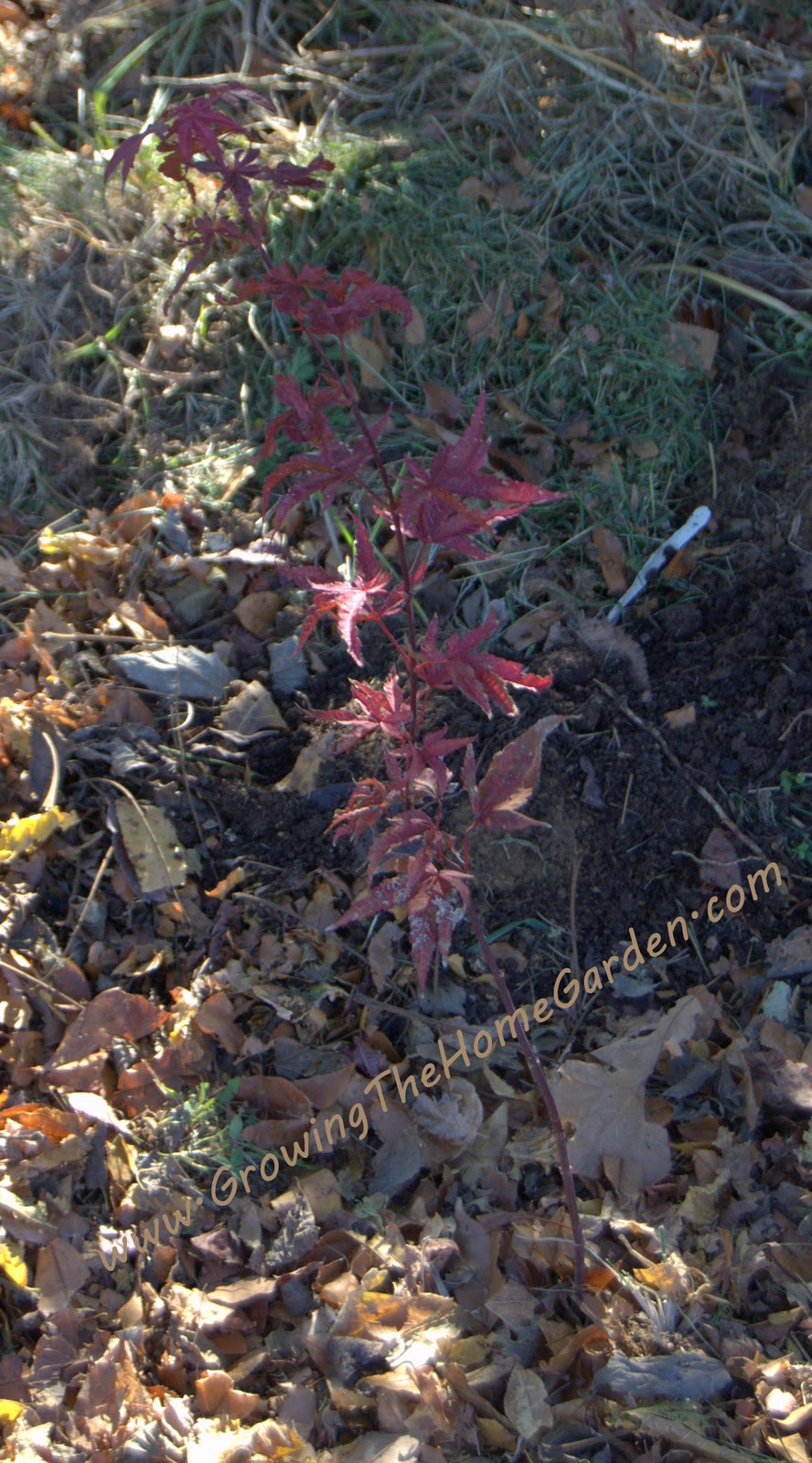
Yesterday would have been my father's 68th birthday.  He was a Halloween baby born back in 1943 but since July 6th, 2011 we've been without my dad.  I think about him in some way everyday and I definitely don't need anything to remind me of how much he helped me through life, but to honor my dad in a small way on his birthday I planted a tree.  It's a small tree, just a little a Japanese maple tree, but it has the potential to be a beautiful tree one day.  In fact it's one of many Japanese maples that grew from seed a while back from dad's own tree.  He didn't plant that tree, it was there when he and mom bought the house, but it's been a beautiful tree and he always liked it.  It just seemed to be an appropriate planting as a memorial tree for dad.

I planted the tree for dad in the front garden not too far from the arbor.  I'm expecting the Bradford pear tree in the picture below to not last much longer (either to be removed by me or Mother Nature).   The little sapling is hard to see in the picture but as it grows it will look much more impressive. Its parent plant has a beautiful 12 foot spread now.

How to Select a Memorial Tree


Dad loved trees.  Maples especially because of the shade, but also oaks and nearly any type of tree that he could add.  His favorite tree would probably be the sweet gum.  Despite its messy seed balls it reminded him of where he grew up.  Even if you don't like the seeds you have to admit that sweet gum trees offer some awesome fall color. I'll be posting about dad's trees in my next post, they are looking spectacular right now in their autumn colors. When I was thinking of planting a tree for dad I thought about all the trees he liked, the spot I wanted to plant it in, and the significance of the tree.  Knowing that dad loved trees I knew I really couldn't go wrong with that factor!  The spot needed to be good for the tree and somewhere it would be seen.  The front garden near the arbor seemed just right with morning sun and shade during the hottest portion of the day.  Since the tree itself came from dad's tree it's significance is obvious.  Having the personal connection to the tree makes the memorial tree more special.

Hopefully the tree will live a long and healthy life and will appropriately honor dad's memory.  Perhaps I will start a tradition and plant a tree each year on his birthday.


Join the 2011 Fall Color Project and share the brilliance of Autumn!

A Frosty Friday

First let me apologize for not writing much lately.  Life has been busy and I haven't been able to get into the garden as much.  Things are winding down for the cold season fortunately and while there is still much to do in the garden it always seems more manageable when the weeds are no longer actively growing!  This morning I went out and took a few pictures of the hard frost we received last night.  The temperatures which held so nicely for so long have finally given way to more seasonal temperatures.  I love fall at about 70 degrees but it can't last forever!

Frosted 'Shasta' viburnum


'Sheffield Pink' mum under frost


The backyard and blue shed with a frosting.


 A Japanese maple in frost at sunrise.


Frost doesn't mean that gardening has to end for the season.  There's still the cool season crops which with a little aid in the form of hoop houses can continue to thrive this fall.  Of course you can always bring the herbs indoors to enjoy in your cooking and some vegetables can be grown indoors in a sunny location.  If you don't have a sunny spot you could buy a cheap shop light with fluorescent lighting to keep on gardening right on through winter.


How will you continue gardening this winter?


Paul from Bountiful Blessings Farm has a great program on gardening through the winter if you're interested. It's a video series that I'm positive you will learn from.  Please go check it out using this affiliate link (Born to Grow).  I've visited Bountiful Blessings Farm and seen what they do first hand.  I highly recommend them!

Japanese Maple Seedling Update

Last year I told you about the Japanese maples that grew naturally from underneath a tree at my parent's house. I over wintered young trees in my garden shed (see the April Video update) and have been taking care of them here in our garden. The other day I transferred the Japanese maple seedlings from the shed because it was getting way too hot inside and moved the little trees to a raised plant holding bed I built out of reclaimed lumber. The 38 Japanese maple trees are doing great! Right now I have them in small pots which eventually will need to be upgraded as the root systems grow. I covered the bed with an old screen door to prevent rabbits from damaging the little trees.


These were all grown by mother nature but should you try to grow Japanese maple trees from seed remember that the seeds require a period of cold stratification. Putting the seeds in a plastic bag of moist sand in the refrigerator for about three months will work. Then plant the seeds outside and watch them grow! I haven't tried this but I suspect if you have cold enough winters simply planting the seedlings in an unused bed in the fall will get you the stratification you need. Stratifying the seeds yourself will probably improve germination rates though.

Depending on the variety of Japanese maple you select the seedlings may not come true to the parent plant. Some varieties come true while others don't. In the picture above you'll notice that the coloring is different between seedlings. The trees that have received more consistent sunlight have developed the red tints while the others are more green.

How Easy Are Japanese Maple Seeds to Grow?

Have you ever wondered about growing Japanese maple seedling in your garden?  It's not hard to do at all!  Watch this video and see how easy it really is!


Here is a little more info on growing Japanese maples from seed.

'Beni Shichihenge' Japanese Maple (Acer palmatum)

Last week I attended the Bloom N' Garden Expo in Williamson County, TN.  It's a neat event held each year that offers garden speakers, display gardens, and (of course) plant vendors!  I've been getting pickier in my plant selections over the past year or so because I want unique plants for my garden.  I'm not trying to fill it up anymore, just trying to make it interesting!  Also money is an issue.  Despite advertising here on this blog (which doesn't earn much) and my fledgling nursery venture we're still really just a single income family. I don't want to spend money on plants I can raise from seed or through cuttings.  Nor do I want to spend money on plants that I don't have a good place to plant them.  So I've been getting more picky.  Fortunately at these kinds of shows there are unique plants to find like the 'Beni Shichihenge' Japanese maple I bought!


'Beni Shichihenge' came home with me because it has some really interesting variegated foliage.  It begins with red on the leaf edges in the spring which eventually changes toward a creamy white variegation.  This Japanses maple is a slow grower and at its top height will reach about 12 feet tall.  For now it will grace itself in a pot either on our front porch or back deck.  I don't have the perfect place planned for it yet and I'm hesitant to place it in a landscape that is also known as the Bambi buffet!

I bought 'Beni Shichihenge' from an extremely knowledgeable and very personable nursery owner out of a North Carolina nursery called Nichols Nursery.  Tim Nichols told me that they have over 700 varieties of Japanese maples in their nursery which also has an online presence at Mr. Maple.  I think you can guess how it got its name!

'Beni Shichihenge' was grafted onto another Japanese maple root stock.  This is commonly done with Japanese maple cultivars since most of them don't enjoy growing on their own roots.  Seed grown grafting stock gives these fancy cultivars a good chance of survival with a strong root system.  One common root stock used for grafting Japanese maples is Acer palmatum 'atropurpureum' which is a red leaved Japanese maple.

Germinating Japanese Maple Seeds in a Plastic Bag

I love a nice Japanese maple!  Who doesn't?  There are Japanese maples  with variegated leaves, ones with deep burgundy colors, others with interesting shaped leaves that are highly dissected and many other kinds.  The fall color on a Japanese is almost always guaranteed to be something special.  Their highly ornamental nature makes them very popular trees in the landscape.  Last summer I gathered up quite a few seeds from a 'Bloodgood' Japanese maple (Acer palmatum) located in my mom's garden with the idea that I would grow more Japanese maples from seed.

Japanese maple

Germinating Japanese maples - growing from seedI collected the seeds from the tree when they had turned reddish in color which was on July 10, 2012.  I placed them in a plastic bag with a slightly damp paper towel (important: not soaking wet, just slightly damp).  Then I put the bag of Japanese maple seed in the refrigerator to stratify.  Stratification is the cold treatment process that allows natural growth inhibitors to break down inside the seed and trigger germination.

Germinating Japanese maples - growing from seed

I put the bag in a plastic box container where I keep several other kinds of seed.  Since I've been seed starting a lot lately the box has been removed from the refrigerator repeatedly over the last few weeks which has triggered their germination.  Today I separated out the germinated seed and found over 80 Japanese maple seedlings emerging!  I put the Japanese maple seeds that were sprouting into three little pots, covered them with a small amount of soil, then put plastic wrap over the top of the pots to keep the humidity inside where the seeds need it.

Germinating Japanese maples - growing from seed

Once they get a couple leaves I'll pot them individually into some small pots and grow them on to planting sizes.  These Japanese maple seeds should resemble the parent plant fairly closely but if you do this with other types of Japanese maples the results can be quite different from the parent. Most unique cultivars are grafted onto a different root stock from another Japanese maple variety.
 

Germinating Japanese maples - growing from seed


One of these days I hope to try my hand at grafting and these Acer palmatum seedlings might be a good rootstock to use.  Have you grafted Japanese maples before?

Japanese Maples from Seed Update!

Have you been wondering for months what ever became of Dave's Japanese maple seedlings? I bet you have...er well maybe not but I'll show you even if you weren't wondering all winter about my Japanese maple seedlings!  In case you are wondering how to grow Japanese maples from seed the big secret is stratification. Stratification is where you expose a seed to cold temperatures in order to break the natural dormancy of the seed. Many plants require a certain amount of cold time in order to trigger germination and Japanese maples are one of them. This is one reason why so many gardeners stores their seeds in the refrigerator. Aside from keeping the seeds fresh the refrigeration also exposes them to cold temperatures so that when the gardener is ready to plant so are the seeds. But enough of my horticultural ramblings, now on for the Japanese maples seedlings!

Nearly all of the Japanese maples that I stored in the garden shed have come alive with new foliage. I was concerned with the winter cold  - that it might have been too much for them, but thankfully my fears were unfounded. These little maples all came from the seed dropped by a Japanese maple in my parent's yard. Germination last year was incredible. Over 140 Japanese maples germinated. Unfortunately the summer took its toll and not all came through to fall but those that did are on their way to becoming some awesome little trees. I'm hoping that this year the seed germination results will be similar since our winter temperatures were comparable to the Winter of 2009-2010.


What variety are they? I'm glad you asked! I'm about 95% positive they are 'Bloodgood' seedlings which is a very common Japanese maple and can be easily grown from seed. These trees could one day become landscape plants or even serve as grafting root stock for other varieties of Japanese maple. 


Have you ever gotten Japanese maple seedlings from your trees?